Fedorov accuses army chief of splitting the country after shock sacking
President Volodymyr Zelensky's decision to remove popular Defence Minister Mykhailo Fedorov has ignited street protests and triggered a damaging public rift with the country's military leadership.
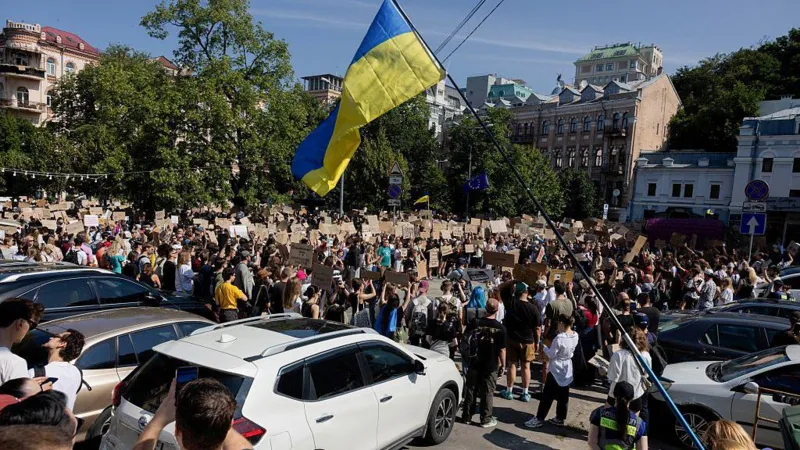
Hundreds of protesters, many of them young, have gathered in central Kyiv and other Ukrainian cities to demonstrate against President Volodymyr Zelensky's surprise dismissal of Defence Minister Mykhailo Fedorov, a widely popular reformer who had been in post for only six months. Chanting "Shame!" and holding placards reading "Hands off Fedorov" and "Stop sabotaging victory!", the crowds outside the president's office represented one of the most significant public displays of discontent since Russia's full-scale invasion began in 2022 . Similar demonstrations were reported in Lviv, Odesa, Kharkiv and Dnipro, reflecting a breadth of anger that has taken the wartime administration by surprise .
The dismissal, which has not been publicly explained by Mr Zelensky, comes as part of a broader government reshuffle that also saw parliament approve Serhii Koretskyi, the head of state energy company Naftogaz, as the new prime minister following the resignation of Yuliia Svyrydenko . Legislators are due to vote on Mr Zelensky's proposed replacement for the defence portfolio, Interior Minister Ihor Klymenko, although the nomination has done little to quell the unrest . The timing of the upheaval is particularly sensitive, coming at a moment when Ukrainian forces are widely seen to be in their strongest battlefield position since late 2022, with successful drone and missile strikes against Russian logistics and oil infrastructure .
Mykhailo Fedorov, 35, was appointed defence minister in January with a mandate to modernise a ministry many Ukrainians regarded as mired in Soviet-era bureaucracy and corruption. A former minister of digital transformation, he had previously earned public acclaim for establishing a volunteer "IT Army of Ukraine" to conduct cyber-attacks against Russian targets and for leading the "Army of Drones" fundraising campaign, which introduced elements of gamification by awarding military units with credits for destroying enemy assets . His tenure at the defence ministry continued this focus on high-tech warfare, including a successful intervention to persuade SpaceX founder Elon Musk to restrict Russia's use of Starlink satellites, and a significant expansion of Ukraine's domestic drone production and mid-range strike capabilities .
In a dramatic press conference on Thursday, Mr Fedorov effectively confirmed that his dismissal was linked to deep-seated tensions with Commander-in-Chief Oleksandr Syrskyi. He alleged that he had proposed to the president that both General Syrskyi and Chief of the General Staff Andrii Hnatov should be replaced, and that when Mr Zelensky declined, he had offered to try to work with them. "Instead of finding a way of defeating Russia asymmetrically – which is the commander-in-chief's job – he's found a way of splitting our country," Mr Fedorov said of General Syrskyi . He also disclosed that he had refused an offer from the president to remain on his team as an adviser, insisting he was acting according to his conscience and expressing confidence that Mr Zelensky would ultimately resolve the situation .
The dismissal has provoked a fierce backlash from military figures and civil society. Pavlo Yelizarov, a renowned drone unit commander and deputy commander of the Ukrainian Air Force, resigned in protest, describing the sacking as "a great evil for the country's defence capability" . Soldiers on the front line have voiced dismay, with one telling the BBC that it was the "worst mistake Zelensky has made during his entire presidency" and that he knew no one who supported the decision, either within the army or in society . Prominent blogger Serhii Sternenko, whom Mr Fedorov had brought in as an adviser, hailed his former boss as "the best minister of defence in our entire history", lamenting the "bureaucratic obstacles and artificial delays" that had stymied deeper reform .
Analysts have suggested that Mr Fedorov's efforts to clean up defence procurement and bring transparency to a lucrative and notoriously opaque system created powerful enemies. Volodymyr Fesenko, a political analyst, told the Washington Times that an "anti-Fedorov coalition" had formed, spanning parts of parliament and government institutions whose interests were affected by the minister's reforms . While the president has justified the reshuffle as necessary for "renewal" and to prepare Ukraine for another difficult winter, critics have warned that changing defence ministers every six months during a war is profoundly destabilising . The protests mark the first major test of Mr Zelensky's political authority since last July, when he was forced to reverse an unpopular law curbing anti-corruption agencies .