Federal judge blocks Justice Department subpoena for Georgia election workers' data
A federal judge in Georgia has refused to enforce a grand jury subpoena seeking information about 2020 election workers, delivering a significant setback to the Justice Department's long-running inquiry
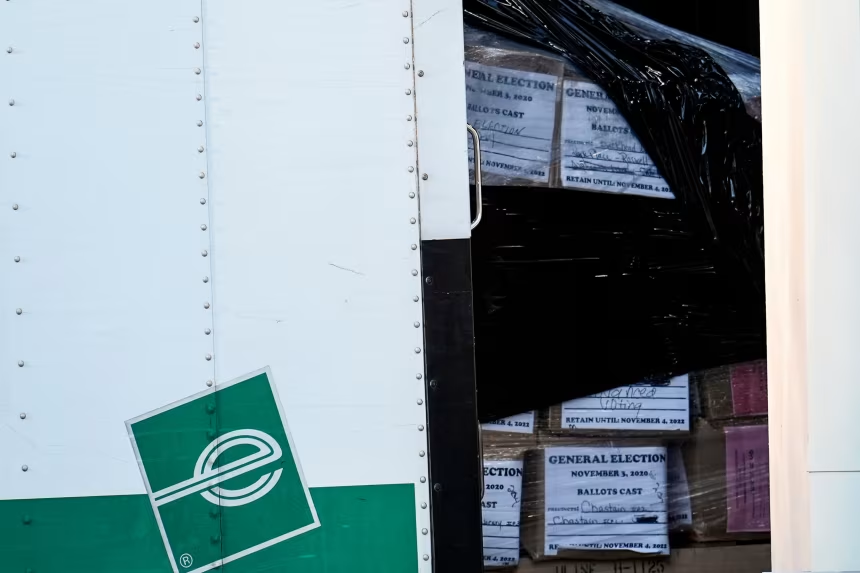
A federal judge in Georgia has dealt a significant rebuff to the Justice Department's investigation into the handling of the 2020 election in the Atlanta area, blocking a grand jury subpoena that sought information about election workers in Fulton County. The ruling, handed down on Tuesday by US District Judge William Ray, represents the latest judicial obstacle to the Trump administration's efforts to revisit electoral processes that have long been the subject of the president's unsubstantiated claims of widespread fraud. Judge Ray described the breadth of the subpoena as "staggering", further ruling that the use of such powers to investigate the 2020 election was not legitimate, given that the statute of limitations for any potential offences had expired.
The judge's order came after it emerged during a prior court hearing that the Justice Department intended to interview election workers as part of its inquiry. "In this Court's view, the DOJ does not possess a need to enforce the Subpoena greater than the burden of disclosure on Fulton County, and as such, the Court will not enforce it," Judge Ray wrote, delivering a clear statement of judicial reluctance to countenance what he viewed as an overreach. The federal proceeding revealed two principal reasons for the department's desire to re-examine the 2020 result in Fulton County: federal investigators alleged that the county had potentially failed to preserve its images of ballots "for the time required by law", and further claimed that "a certain number of the actual 2020 ballots that it seized pursuant to a search warrant look suspicious", according to the judge's order.
The judge also raised concerns about the procedural validity of the grand jury action, noting that no evidence had been presented to demonstrate that the actual grand jury in the Northern District of Georgia sought the information in question, as opposed to out-of-district prosecutors appointed by the department to lead the inquiry who had served the subpoena in the grand jury's name. The ruling constitutes one of several court defeats the Trump administration has suffered as the president remains fixated on his unfounded allegations of mass electoral fraud in 2020. Undeterred, however, the Justice Department has this week made fresh attempts to insert itself into election administration across the country.
A letter from the department's Civil Rights Division, sent to state elections offices and obtained by CNN, threatened criminal punishments for election officials who send mail ballots to non-citizens. The threat comes as the department has faced legal hurdles in its attempts to obtain unredacted voter rolls from each state to conduct its own audit of registration files, which can contain sensitive information such as social security numbers. Multiple states, including Arizona and Minnesota, have received such letters. Civil Rights Division chief Harmeet Dhillon wrote that any election officer who "knowingly retains noncitizens on the state's [voter rolls] or facilitates noncitizens in receiving and casting ballots could be subject to criminal liability", adding that any other "intentional act that is aimed at diluting the votes of citizens" could also constitute a federal crime.
Separately, the Justice Department informed election officials in Detroit and two other Michigan cities of its intention to send election monitors for the state's August primary. State and local officials aggressively pushed back on the department's letters, which suggested the cities had not complied with federal election law in 2024. Michigan's secretary of state and attorney general confirmed on Monday that three cities – Lansing, East Lansing and Detroit, all Democratic strongholds – had received correspondence from the department. The DOJ is seeking certain records related to poll worker training and other aspects of election administration, according to its June 24 letter to Detroit.
In a response dated Tuesday, Detroit City Clerk Janice Winfrey dismissed the department's claims as based on "falsehoods" and denied that there had been long lines at some polling places, as the DOJ had alleged in its letter. Federal election monitors are, in practice, routine observers of the electoral process and are commonly dispatched across the country ahead of elections. Ms Dhillon responded to concerns from state and local leaders in a video posted on social media on Tuesday, stating: "To be clear, both Republican and Democrat administrations have sent monitors to Michigan and these other jurisdictions in the past. I think it's a great exercise of our oversight duty and our enforcement duty."
Lansing Mayor Andy Schor and City Clerk Chris Swope issued a joint statement welcoming election monitors and indicating that the city would "gladly provide documents and information in response to all lawful requests". "Voting in Lansing is safe and secure, and there has never been a history or any indication of issues in our election process," the statement read, while adding a firm caveat: "But let's be clear, Lansing voters will not be harassed or intimidated by election monitors from either the federal government or any other group." The developments underscore the deepening tension between the Trump administration's determination to pursue election-related inquiries and the resistance it has encountered from both the judiciary and state and local officials, as the president continues to challenge the integrity of electoral processes that have been repeatedly certified and upheld.