English pupils outshine rest of UK in global school rankings
England ranked above Scotland, Wales and Northern Ireland in all three core subjects of the latest Pisa tests, though the OECD report warns of a steep global decline in reading comprehension, with the share of teenagers rushing through texts almost doubling since 2018.
Pupils in England have outperformed their counterparts in Scotland, Wales and Northern Ireland in the latest round of international school tests, according to the Programme for International Student Assessment (Pisa), which surveyed 760,000 15-year-olds across 91 countries. England ranked above the other home nations in reading, science and mathematics, maintaining a pattern of divergence that reflects significant curricular differences across the UK. However, the report, published every three years by the Organisation for Economic Cooperation and Development (OECD), also delivered a stark warning about a worldwide decline in reading skills, particularly the ability to critically evaluate information from diverse sources—a competency the OECD described as "matter[ing] most in the age of AI". The proportion of "hasty readers", who rush through texts and provide quick, incorrect answers, has nearly doubled between 2018 and 2025, with the sharpest fall observed among students from "relatively well off" families.
In the UK, where education policy is devolved, 15,566 students from 515 schools took the tests. England's strong performance was welcomed by schools minister Georgia Gould, who said the government wanted to "build on" the positive results and "go further so all young people leave school with strong literacy and numeracy". Gould held up high-performing Estonia as an example of where "academic excellence can go hand in hand with high-quality vocational routes", pointing to recent reforms that will make technical subjects available to students from age 14. "Our reforms will build on England's strong academic foundations so future generations not only perform well, but feel connected to school and excited about where their education can take them," she added. Her shadow counterpart, Laura Trott, attributed England's success to previous Conservative reforms and accused the new government of attempting to "sabotage" them.
Wales, which lags behind the rest of the UK overall, nevertheless outperformed European nations including France, Spain and the Netherlands in science. As the tests were taken last year, the results largely reflect learning under an old curriculum that has since been revised. Wales' education minister, Anna Brychan, acknowledged that the results "highlight our need to improve standards of reading and maths, as a priority" and said plans were in place to support schools. Scotland's education secretary, Mairi McAllan, said the results showed "real strengths in Scottish education, as well as areas we're already working to improve", but Scottish Labour countered that results had "flatlined since 2022's historically poor results", while the Scottish Liberal Democrats said the system under the SNP had "tumbled down the rankings, lagging behind England on every measure of performance". Northern Ireland's education minister, Paul Givan, said pupils there had performed well by international standards but acknowledged "significant challenges" and that "there is much more work to do".
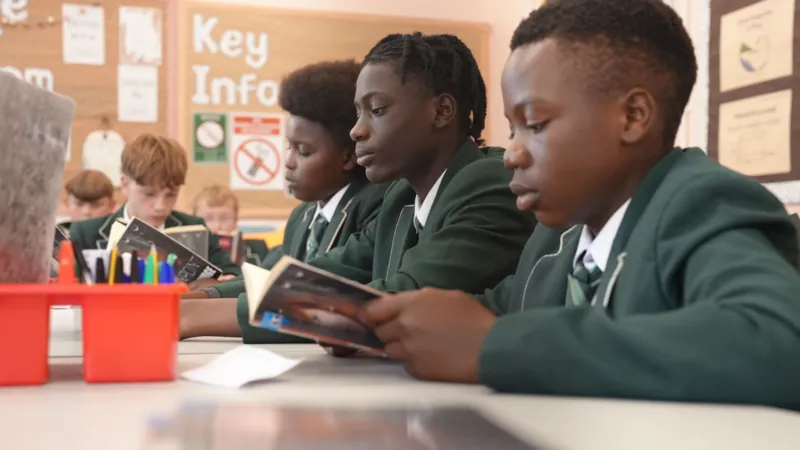
The OECD's director of education, Andreas Schleicher, described reading as the "mother of all skills" and expressed concern over the steep global decline, which he said amounted to the equivalent of "two school years" in the last decade. Longer-term Pisa research suggested that students who read longer books performed best, as it helped them to hold complex information in mind. Schools such as Meadow Park in Coventry have adopted a range of approaches to improve reading, including weekly book club discussions led by tutors. Year 10 pupil Ampaabeng said the sessions had a "really positive impact" on his reading since they were introduced a year ago. The school has also invested in a wider library collection and encourages reading for pleasure at lunchtime, while a mobile phone ban introduced two years ago has reduced distractions—a measure commended by the report. "In a digital age, it's easier to pick up a phone than it is a book," said head teacher Bernadette Pettman. "Reading together has enabled us to break down that fear of reading, and pupils have absolutely embraced it."
The OECD report also highlighted the growing influence of artificial intelligence on education, warning that excessive use can lead to "cognitive off-loading", where pupils avoid looking up information themselves. In the UK, a relatively high proportion of teenagers reported never having used AI for schoolwork, but the OECD cautioned that countries were allowing the rapid spread of AI without evidence of its impact, likening it to rolling out an untested vaccine on children. Schleicher called on governments to provide clear guidelines and consider whether AI could be used in a targeted way to support teaching rather than to "give quicker answers" to students. The Pisa tests, which provide the largest global snapshot of education systems, serve as both a benchmark and a warning: while the UK performs well overall, the widening gaps between its constituent nations and the global erosion of reading skills present pressing challenges for policymakers.