Disinformation War: Ukrainian Journalist Exposes Flaws in Western Coverage of Conflict
Natalia Voitovych, coordinator of the Lviv Journalists’ Solidarity Center, contends that Western media have repeatedly misread the war’s origins and resilience, while Russian propaganda continues to distort international perceptions.
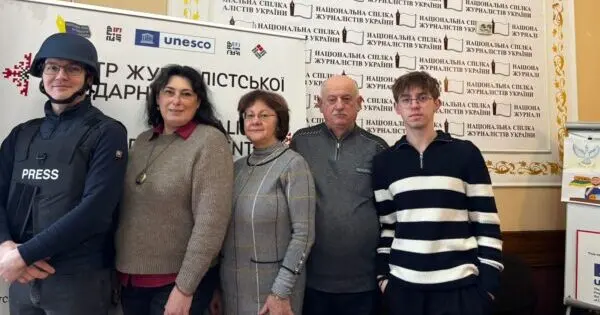
In conversations with Ukrainian lawyers and activists, three recurring frames have emerged concerning Western media: what it captures accurately, what it distorts, and what it overlooks entirely. Natalia Voitovych, a Ukrainian journalist and disinformation researcher who coordinates the Lviv Journalists’ Solidarity Center within the National Union of Journalists of Ukraine’s nationwide network, suggests that Russian propaganda has entrenched itself firmly within Western information spaces, constituting a parallel theatre of conflict that is often underestimated. Some outlets and commentators, she argues, repeat Russian narratives either for ideological convenience, to court specific audiences, or simply because Russian-language material is more readily accessible to European journalists who learned the language during the Soviet era. Yet these sources, she cautions, are overwhelmingly aligned with the Kremlin and do not furnish a reliable picture of events on the ground, thereby fostering a profoundly distorted understanding among international audiences.
Speaking at the Journalists’ Solidarity Center in Lviv, a hub established in the wake of the 2022 full-scale invasion to assist displaced reporters with equipment, protective gear, and workspace during blackouts, Voitovych stressed that the conflict did not commence in 2022 but in 2014, with Russia’s seizure and annexation of Crimea and the fomenting of separatist hostilities in the Donbas. For years, she observed, many European outlets treated the fighting as an internal Ukrainian affair—a “civil conflict” or a struggle involving “separatists”—rather than correctly identifying it as Russian aggression. That initial misframing, she contended, ranks among the most consequential errors in Western reportage. Russia, possessing a vastly larger population, territory, and resource base, was widely assumed by foreign commentators to be unbeatable; the notion that a smaller nation could withstand such an onslaught was dismissed as implausible until the Ukrainian resistance proved otherwise.
The full-scale invasion, now entering its fourth year, has demonstrated that a smaller country can indeed resist a much larger aggressor, and Voitovych emphasised that Ukraine is defending not only its own sovereignty but the broader European security order. Should Ukraine fall, she warned, the threat would not necessarily cease at its borders, increasing the risk of further instability and coercion across the continent. Prior to February 2022, some Europeans had begun learning Ukrainian, but it was not widely prioritised; when the invasion commenced, certain Western media outlets initially predicted Ukraine’s rapid defeat. That narrative was later revised, but only after the Ukrainian public—painters, bakers, singers, musicians, seamstresses, and journalists among them—mobilised in extraordinary numbers, forming long queues for weapons and volunteering to defend their neighbourhoods and cities.
Voitovych, who was interviewed by Polish media in 2022 and declared that she would take up arms if the war reached Lviv, described the defence of Kyiv in the early days of the invasion, when civilians faced armoured vehicles with whatever weapons they could obtain. “They gave people weapons, and they went to defend their neighbourhoods and their cities themselves,” she recounted. This spontaneous mobilisation, she noted, contradicted the Kremlin’s propaganda narrative that Ukraine was too weak to resist and too divided to unite. The shift in Russian disinformation over time has been equally telling: initially, Moscow claimed it was “protecting” or “liberating” Russian-speaking populations, a narrative that Voitovych dismissed as baseless, pointing out that Lviv operated multiple Russian-language schools and that public life remained bilingual until around 2016–2018, with concerts and programmes often featuring both Ukrainian and Russian.
When that framing became untenable, Russian propagandists pivoted to claims of “returning Russian lands,” despite Ukraine’s internationally recognised sovereignty after 1991, and they maintained that Ukraine was not a genuine country but a creation of Lenin, ignoring the fact that Kyiv predates Moscow by centuries. European and world media, Voitovych argued, must return to history and read it seriously—not only Russian state narratives but also accounts from French, Italian, Spanish, and other historians and travellers from the fifteenth and sixteenth centuries who documented the region and mapped Ukraine. She noted that Western media are often new to this context and susceptible to absurd propaganda, such as the claim that Ukrainian people “eat Russian boys” in Lviv, a trope she likened to historical blood libels. The problem, she suggested, is compounded by the Budapest Memorandum of 1994, under which Ukraine surrendered the world’s third-largest nuclear arsenal in exchange for assurances of its sovereignty and borders from the United States, the United Kingdom, and Russia. Russia later claimed the memorandum was non-binding, a mere political statement, and Voitovych expressed personal regret that Ukrainians had trusted those guarantees.
This sense of betrayal, she elaborated, resonates deeply in Ukrainian society: first, aggression from a former Soviet “brother,” and second, the absence of hard military protection from the very powers that had promised to safeguard Ukraine’s integrity. When civilians, the military, and President Volodymyr Zelensky declare “no territorial concessions,” Voitovych understands the position as rooted in a conviction that rewarding an aggressor invites further aggression. “If we make territorial concessions, it will be a disaster,” she said. “You cannot give the aggressor what they want. If we agree to give them our territory, they will not stop.” The biggest message from the Ukrainian side, she insisted, is that Putin must not achieve any of his political objectives, because he will then pursue more.
Turning to press freedom, Voitovych noted the stark divergence between Ukraine and Russia in the Reporters Without Borders World Press Freedom Index. Ukraine improved from 106th in 2022 to 62nd in 2025, while Russia fell from 155th to 171st, a clear and accelerating gap. Moldova, by contrast, ranks 35th. Despite the war and martial law restrictions, Ukraine has made progress, though concerns remain about occasional interference with journalists near the front line. In Russia, the picture is far grimmer: journalists are detained, abused, and subjected to torture, with credible UN-linked documentation indicating systematic mistreatment. “For me, it is not just low—it is below zero,” Voitovych stated, describing Russia’s press environment as fundamentally criminal, because for the Kremlin, journalists are targets to be eliminated. She traced this hostility to Putin’s early consolidation of power, which involved silencing independent journalists, aligning with oligarchs to reinforce political loyalty, and building a system of patriotic messaging to mobilise Russians around the state—all before any territorial expansion.
The Journalistic Solidarity Center, which Voitovych coordinates, was established in 2022 when mass displacement following the invasion brought journalists from occupied or heavily attacked areas to Lviv, which became a hub. A Greek journalistic community was among the first to assist, delivering supplies—food, laptops, phones, cameras—in March 2022, because many reporters had fled without equipment. The centre distributed aid, helped journalists find accommodation, and supported them in continuing their work. By the summer of 2022, it was decided to create multiple hubs, and UNESCO began providing funding, bulletproof vests, helmets, and medical supplies. Today, there are six hubs across Ukraine, including in Zaporizhzhia, Kharkiv, Dnipro, and Kyiv, where journalists can borrow protective gear and then proceed to the front with improved safety.
The centres also serve as workspaces during blackouts, which have become frequent as Russia attacks Ukraine’s energy system, and they host trainings on fact-checking, information warfare, propaganda, journalistic ethics, security, and medical response. “Many journalists entered or re-entered the country in 2022, and many came from the east after fleeing their homes with no equipment and no protective gear. The hubs helped fill that gap,” Voitovych explained. Russia, she emphasised, targets journalists alongside medics, and the centre tracks the fate of Ukrainian journalists held in captivity, including Viktoriia Roshchyna, who was killed in Russia after requesting psychological help. The National Union of Journalists has petitioned on behalf of Roshchyna and other detained journalists, underscoring the systematic nature of Russian repression.
On the question of territorial concessions and the broader geopolitical calculus, Voitovych argued that Western media must avoid reducing human losses to statistics. She recounted the story of her cousin, a 25-year-old medic and journalist who went to the front at barely 18, served with the Hospitallers, and died two days before her birthday—a Hero of Ukraine who will remain 24 forever. “If we write only that someone died, it is sad,” she reflected. “If we write about the person they were, it becomes an honour.” She acknowledged the four broad categories of men in Ukraine—those who left, those who hid, those who were coerced into mobilisation, and those who chose to fight—and expressed respect for all who contributed, even in small ways, such as the two young girls she saw pouring petrol into a generator during a blackout to keep a café running.
When asked about Russian families who oppose the war but feel compelled by economic necessity to participate, Voitovych recommended watching videos of Russian prisoners speaking with their families, where they often describe the war as a means to acquire something. “Most Russians do not analyse. They unquestioningly believe what they are given,” she said. “Many Russian families do not want to see the full situation. They close their eyes. That is not critical thinking.” She also noted the presence of foreign nationals in the conflict, including Indians misled into serving in the Russian army, North Korean forces, Iranian Shahed drones, and Western-aligned volunteers on the Ukrainian side, though she deferred to military experts for precise figures.
Voitovych concluded by reflecting on the importance of human stories in journalism, cautioning against treating casualties as spreadsheet entries. She welcomed the interviewer’s approach of coming with fewer expectations, allowing for a more accurate perception, and she emphasised that Ukraine’s resilience is manifested not only on the front line but in everyday acts of endurance and mutual support. The war, she said, has revealed the depth of the Ukrainian nation, and it is that depth—rather than any strategic calculation—that foreign journalists must strive to convey.