Devil Island’s brutal past paves way for Mediterranean monk seal sanctuary
Once a byword for political repression and military bombardment, the Aegean outpost of Gyaros has emerged as an unlikely stronghold for the critically endangered Mediterranean monk seal and other rare species
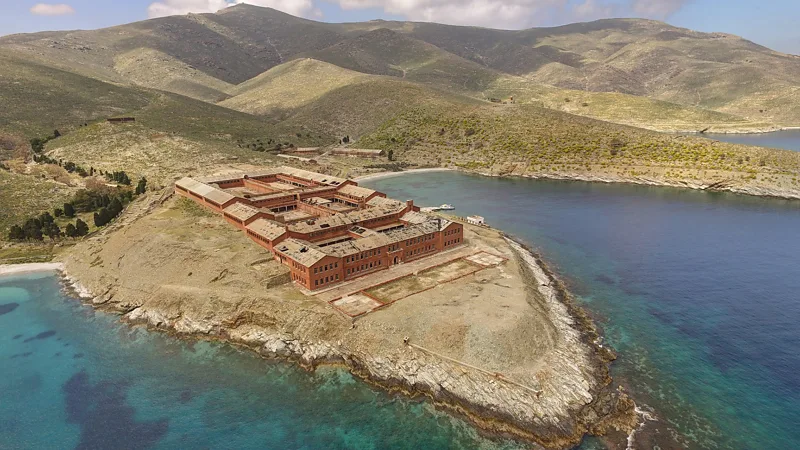
The sun had already climbed well above the speedboat’s mast when the silhouette of Gyaros first broke the Aegean horizon, a barren and forbidding presence against the morning glare. Half an hour’s sailing from Syros, the administrative capital of the Cyclades, the island could scarcely offer a greater contrast to its celebrated neighbours. Mykonos and Andros, with their sugar-cube villas cascading down hillsides and their quayside tavernas thronging with visitors, embody the Grecian idyll. Gyaros, by contrast, never received that particular memorandum. As the boat draws nearer, a hulking edifice of red brick materialises from the scrub and scree – the prison that earned this place its grim epithet, “Devil Island”.
Yet for all its desolate appearance, Gyaros is far from lifeless. The reasons for this paradox lie buried in one of the more violent and shadowed chapters of modern Hellenic history. A succession of authoritarian regimes and a subsequent period of military training left the island untouched by the development that swept across the rest of the archipelago, preserving it as a forgotten relic of a turbulent past. Then, in an unexpected twist, a single photograph taken in 2004 drew fresh attention to this apparently forsaken outpost, though for reasons entirely unconnected to its political legacy. It emerged that Devil Island had, in the decades of human absence, transformed into a haven for a species of seal then teetering on the brink of extinction.
Isolation, violence and punishment have been the recurring motifs of Gyaros’s long history, with the island serving as a place of exile for political prisoners since Roman times. Its most savage incarnation, however, commenced in 1948, when the Greek state expropriated the properties of its last 31 inhabitants and converted the island into a penal colony. While neighbouring islands were erecting boutique hotels and courting tourists, Gyaros was sealed off from the outside world. Across two distinct waves of political repression, more than 20,000 Greeks – predominantly communists, writers, students and artists who had voiced opposition to those in power – were dispatched to its shores. During the first wave, in the late 1940s after the conclusion of the Greek Civil War, inmates were compelled to live in tents, enduring sweltering summers and freezing winters as they laboured to construct the very brick walls that would confine them. Following a hiatus, a second wave of imprisonment occurred under the military junta of the “colonels” from 1967 to 1974. Ostensibly a reformatory designed to mould dissidents into “true Greeks”, Gyaros was in practice a site of forced labour and torture, conveniently tucked from critical view. After the collapse of the dictatorship, the Hellenic Navy utilised the island as a bombing range until 2002. To this day, it possesses no hotels, no ferry connections and no permanent residents. Almost by accident, Gyaros had received the most robust protection conceivable: the complete absence of humanity.
With the cessation of naval activities, local fishermen began reporting sightings of Mediterranean monk seals in the waters surrounding the island. The catalyst for systematic investigation, however, came in the form of a photograph taken by an amateur speargun fisherman in the early 2000s, which depicted a monk seal mother and her pup lounging on an open beach in broad daylight – a spectacle that had become all but extinct across the Mediterranean basin. “Personally, I had never seen it in Greece,” recalled Panos Dendrinos, a biologist with the Hellenic Society for the Study and Protection of the Monk Seal, an Athens-based research organisation. “It looked like an ancient picture.” Once a common species, by the late 20th century the global population of Mediterranean monk seals had collapsed to between 350 and 450 individuals. Centuries of hunting for their fur, meat and blubber, combined with coastal development that destroyed their habitat and fishermen who killed them in retaliation for raiding nets, had driven the species to the edge. Classified as critically endangered, the survivors had become phantoms, retreating to remote sea caves to raise their pups far from human contact.
The fisherman’s image prompted the first scientific expeditions to Gyaros, where researchers discovered a substantial colony of approximately 70 adult seals – possibly the largest remaining aggregation in the Mediterranean at that time. More remarkable still was the animals’ conduct: seals were nursing their young on open beaches, a behaviour that astonished experts. “That was their natural behaviour,” observed Spyros Kotomatas, a biologist and senior marine conservation officer at WWF Greece, who was then working with the Hellenic Society for the Study and Protection of the Monk Seal. “Seals elsewhere behaved like Greeks in Athens – tense, alert. On Gyaros, they were relaxed.” It remains unclear precisely how long the seals had occupied the island, but Mr Kotomatas suggests that its protracted isolation had created favourable conditions. Although thousands of prisoners passed through, the human footprint was concentrated, with the camps occupying only a small portion of the coastline. Even during the bombing era, disturbance was sporadic and primarily confined to the south-east of the island, away from the areas where the seals found refuge. “Seals are adaptable,” Mr Kotomatas added. “I’ve been inside a cave while a speedboat passed right by. I couldn’t hear from the noise, but the seal remained asleep.” Crucially, the navy’s presence meant that fishing was not recommended, thereby creating a rich feeding ground. The discovery of the seals led to several developments in the island’s protection, culminating in 2019 with its designation as a Marine Protected Area, the first of its kind in the region.
From the speedboat, Antonios Burikas and Ventouris Bountouris scan the water with practised eyes. As officers of Greece’s Natural Environment and Climate Change Agency, which assumed surveillance duties from WWF in 2023, their task is to verify that no fishing is taking place within the three-nautical-mile protected zone. On this particular day, the water remains quiet, with only two pleasure yachts anchored in the bay below the prison. The officers politely inform the captains that fishing is prohibited. “More than the patrols themselves, it’s the idea that we are patrolling that deters people,” Mr Burikas observed. Sea life around Gyaros enjoyed significant advantages long before active protection was instituted. Fishing had been banned for safety reasons by the navy and was never systematically opened to large-scale mechanisation. Nevertheless, the island’s remoteness and its exposure to frequent high winds make it difficult to guard against illegal fishing. As the bombing range fell silent in the early 2000s, more boats moved in to exploit waters that had been scarcely fished for half a century. Constant boat patrols to prevent this proved prohibitively expensive, so in 2017 WWF Greece constructed a remote monitoring system that transmits live feeds to Syros. When a vessel enters the protected zone, officers can dispatch a targeted response. “It’s more or less Big Brother,” said Dimitrios Damalas, a fisheries expert at the Hellenic Centre for Marine Research in Anavyssos.
Between 2015 and 2023, illegal fishing incidents involving amateur fishers fell by 57 per cent, while those involving professional fisheries dropped by 85 per cent. Surveys led by Mr Damalas have recorded more than 130 distinct species within the protected waters, compared with 108 outside. Fish are both more numerous and larger. Maria Salomidi, a marine biologist at the Hellenic Centre for Marine Research who has studied seagrass beds and reefs on Gyaros since 2009, reported seeing slipper lobsters in improbable numbers, along with giant devil rays, marine turtles, dolphins, whales and monk seals. “When we dive elsewhere, we’ll mostly get out of the water frustrated,” she said. “We see the degradation in the sea. Not in Gyaros… [It’s] one of the last heavens on Earth, where you can hear the silence and see the night sky.”
High on the cliffs and in burrows carved into the rock, Gyaros harbours another species vulnerable to extinction. In 2015, researchers from WWF detected a group of Yelkouan shearwaters – black-and-white seabirds roughly the size of a rock pigeon – approaching the island at night. Their presence had previously been unknown; the birds were thought likely to be confined to smaller, isolated islets. Long-lived and monogamous, shearwaters return to the same partner and nesting site year after year. On land, their world contracts to a single burrow and egg. “One bird can stay on the egg for a week, completely motionless,” explained Danae Portolou of the Hellenic Ornithological Society, who has been leading efforts to monitor Yelkouan shearwaters in the Aegean. “The other travels, then they switch.” The Gyaros colony is the second largest in the world, accounting for 15 per cent of the global population. It is precisely the inaccessibility of the island’s cracks and crevices – a habitat untouched by humans – that has allowed it to flourish. Even here, however, the shearwaters face threats. Introduced rats consume their eggs and chicks, accounting for the loss of up to a third of their eggs. More troubling still, feral pigs, which dig up burrows and prey on adult birds, have now been illegally introduced. “When a predator targets adults of a long-lived, low-fecundity seabird, the damage is devastating,” Ms Portolou warned. A cull of the pigs, the more pressing of the two threats, has commenced, but Ms Portolou stressed that eradicating them with speed is critical.
Nor is this the only imperfection in Gyaros’s current circumstances. While the seagrass meadows surrounding the island are mostly healthy, the reefs are not. Overfishing elsewhere has removed large predators such as groupers and sea bream, with the result that smaller fish are overgrazing the algal forests that form the foundation of the entire ecosystem. Ms Salomidi’s team is now actively restoring the reefs by planting lab-cultivated algae. Large fish such as groupers and sharks are returning, but many remain immature. “We may need decades to approach something close to a pristine state,” said Mr Damalas. Matters are also politically fragile. Even after Gyaros was designated a Marine Protected Area, local small-scale fishing remained permitted seasonally and under strict conditions. But in 2022, under pressure from fishing organisations, the government opened the area, leading to a free-for-all that quickly impacted fish and seals. The government soon reversed course, declaring the island a strict no-take zone. Still, scientists remain concerned that the Natural Environment and Climate Change Agency lacks sufficient capacity to protect the island. “Fishermen report that boats from other islands arrive at night and on weekends,” said Mr Damalas. “[Others] feel they have been respecting the rules for nothing.” In April 2026, a presidential decree conferred the highest level of protection upon the island and established a permanent legal framework.
Experts also stress, however, that Gyaros cannot be a stand-alone solution. While Greece has protected 18 per cent of its marine territory, only a small fraction is actively managed. “Even if you protect Gyaros perfectly, if the wider sea is unprotected, [the] animals remain at risk,” said Mr Kotomatas. “The Mediterranean is one of the most intensively used seas on earth, and pressures from shipping, offshore energy, recreational fishing and marine heatwaves are only increasing.” A proper plan is needed, he added, for how different parts of the sea are used, so that fishing, shipping, tourism and conservation do not end up working against one another. The participatory process used to design Gyaros’s protected area offers a promising model for others to follow, according to Ms Portolou. “It brought together lots of stakeholders to talk and discuss what they feel Gyaros is for them and what is necessary to be done,” she said. “The process has taken time, but it’s been worthwhile.” In one piece of encouraging news, monk seals are now recovering beyond Gyaros, driven by protection of key habitats and a shift in attitudes among fishermen, who no longer dynamite animals in caves, said Mr Kotomatas. As the speedboat turns away from the island, the abandoned prison recedes into the haze. Somewhere near the caves below, monk seals continue to nurse their pups on open shores. “Gyaros is an island of hope,” Ms Salomidi concluded. “But we need a thousand Gyaroses across Greece – then we might be on to something.”