Democrats ride a wave of optimism into Tuesday's midterms
A deeply unpopular Republican president and months of favourable surveys have raised Democratic expectations, yet recent history offers a sober warning about the limits of polling.
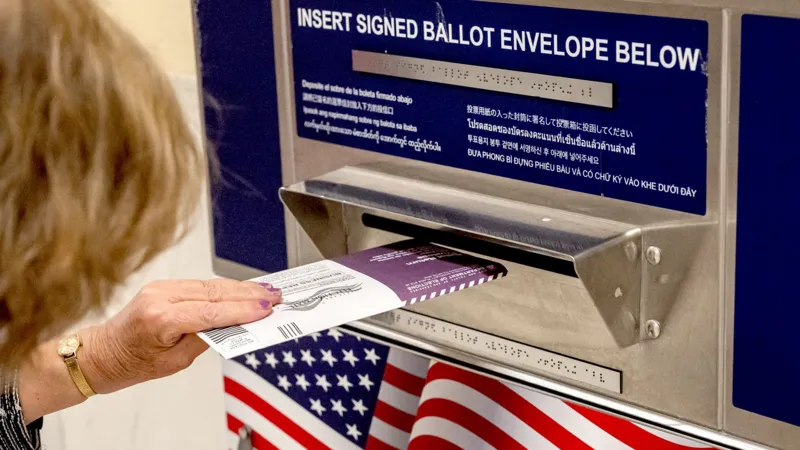
The Democratic Party enters Tuesday's midterm elections buoyed by a rare confluence of favourable conditions. A Republican president languishes in the doldrums of public opinion, voters fret over the rising cost of food and household bills, and months of encouraging polling have persuaded many Democrats that a good night beckons. The party's candidates, the surveys suggest, lead in comfortably more than the 218 seats required to seize control of the House of Representatives, while the key Senate races are tied or narrowly tilting their way. One recent New York Times poll placed the Senate contest in South Carolina, a state Donald Trump carried by 18 points in 2024, level. Surveys for CNN have put the Democrats ahead in Texas, Kansas and Maine. Such figures have understandably lifted spirits.
Whether the polls can be trusted is quite another matter. Recent American political history is strewn with contests in which the surveys, even those published days before voting, misjudged the mood. Trump confounded the predictions on his way to the White House in 2016 and again in 2024, while his narrow defeat in 2020 followed a slew of polls pointing to a more comfortable win for Joe Biden. Earlier this year, surveys suggested Abdul El-Sayed was poised for a double-digit victory in Michigan's Democratic Senate primary. He won by a single point. In Wisconsin's Democratic primary for governor, a candidate enjoying a polling lead of nearly 20 points lost by a fraction of one.
The explanation lies partly in the difficulty of reaching voters at all. Clifford Young, president of Ipsos Public Affairs, which conducts political and market research, says polling has grown harder as Americans abandon landlines and screen their calls, and as those who are contacted grow less willing to take part. Conservatives, and particularly those on the far right, are by temperament hostile to established institutions and disinclined to participate in anything of the sort. Should Republican voters be systematically undercounted, and polling companies fail to account for it when constructing their models, the resulting data would lean towards the Democrats. That is one reason why forecasting the shape of the electorate has become so treacherous.
Trump's past overperformance owed much to supporters, many of them irregular voters, turning out in unexpectedly large numbers. Such unpredictability helps explain the notable polling misses of recent years, even where reputable surveys erred by only a few percentage points. In a tight race, those few points decide the outcome, and several of this year's Senate contests sit within precisely that margin. Midterm polls have in fact proved more reliable of late, partly because Trump and his singular capacity to draw disaffected Americans to the ballot box were absent. In 2022, the surveys correctly anticipated that the Democrats would defy convention and avoid an electoral rout despite Biden's unpopularity. The party lost the House, but narrowly, and held the Senate.
The primary results this year delivered sharper surprises, though Young notes that nominating contests have always been volatile, with voters inclined to make up their minds late. They should not be read as evidence that the general election polls are awry. It is commonplace for the president's party to endure a difficult midterm, most memorably in 2010, when Republicans gained more than 60 House seats and made inroads in the Senate amid a sluggish recovery from the financial crisis and Conservative alarm over Barack Obama's healthcare reforms. The polls foresaw defeat, if not on quite that scale. This time the roles are reversed, with the Democrats in opposition and the economy foremost in voters' minds, yet several factors may deny them the night that history and Trump's low approval ratings might imply.
Much of the contested territory was won with ease by Trump only two years ago, giving Republicans something of a home advantage. Boundary changes have reduced the number of seats that change hands. Deepening polarisation has thinned the ranks of swing voters, with some experts describing the electorate as calcified. Republicans have also enjoyed a financial advantage, spending hundreds of millions of dollars on attack advertisements in the closing weeks. Polling models strive to capture such shifting fundamentals, and a well-designed survey anticipates the flaws that might undermine it. Individual polls carry a built-in margin of error, a statistical allowance for uncertainty arising from the sample size; taken together as an aggregate, polling averages offer a sounder guide than any single survey.
Even the kind of lean seen in recent presidential elections would point to a good night for the Democrats on 3 November, and inaccuracy can cut both ways. In last year's state and special elections, Democratic voters turned out in unexpectedly large numbers and their party outperformed most surveys. The spectacle of Trump holding rallies in the closing days in states he won comfortably in 2024 will have encouraged Democrats to believe that Republican internal polling has found conservative candidates in trouble. Voters may yet change their minds before polling day; late shifts can alter the dynamics of a race, and undecided voters, who remain a significant segment in many contests, may break decisively one way.
Some measure of uncertainty is inescapable, and managing it is the art that accompanies the science. Young, for his part, is cautiously optimistic about his trade. We are doing a better job, he says, but part of the problem is not the pollsters at all. Part of it is that we are dealing with humans, and humans are not easy.