Damascus court condemns ousted dictator and senior regime figures to death
A Syrian court has convicted the deposed dictator in absentia of war crimes and crimes against humanity, while his cousin and six other former officials were also sentenced to death for their roles in the brutal crackdown that ignited a civil war.
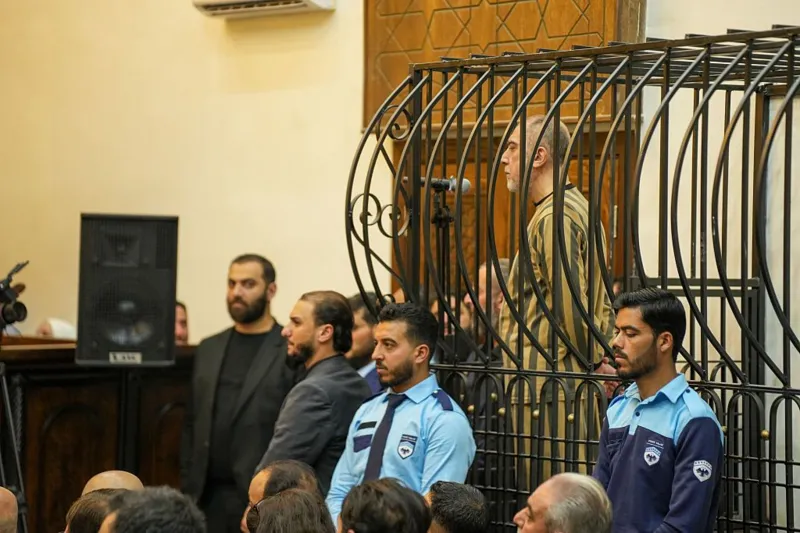
In a historic ruling that marks the first judicial condemnation of the ousted Syrian dictator, a Damascus court has sentenced Bashar al-Assad to death in absentia after finding him guilty of war crimes and crimes against humanity committed during the country's devastating civil war. The verdict, delivered on Monday, represents the most significant legal reckoning yet for the former president, who fled to Moscow with his family in December 2024 as his regime collapsed, bringing an end to his family's five-decade-long iron grip on the country. It is understood that the court also imposed the same penalty upon Atef Najib, Assad's cousin and the former head of political security for the southern province of Deraa, who had been in custody and appeared in the courtroom dressed in a striped prison uniform, confined within a cage as the judge recited his sentence.
Having been widely acknowledged as the crucible of the uprising against Assad's rule, Deraa holds a particularly symbolic place in the narrative of the Syrian conflict. It was in March 2011 that the detention and alleged torture of a group of teenagers, accused of scrawling anti-government graffiti on a school wall, ignited protests that spread through the city. The security forces' violent response to these demonstrations, according to reports from the time, acted as a catalyst for nationwide unrest, which rapidly escalated into a full-blown civil war that claimed hundreds of thousands of lives. In the wake of Assad's overthrow, Syria's interim government, which assumed power as the new authorities, initiated a series of legal proceedings earlier this year against officials associated with the old regime, which had governed the nation for more than half a century.
Najib, who stands as one of the most senior figures from the deposed administration to be brought before a court, was convicted on a range of charges including murder, the intentional killing of children under the age of 15, and torture leading to death. In a broader sweep of justice, the court also handed down death sentences in absentia to six former military and security officials, among them Bashar al-Assad's younger brother, Maher, who commanded the army's elite Fourth Division and, like his sibling, is now a fugitive in Moscow. The list of the condemned was said to include Fahd al-Freij, a former defence minister, whose name was read out alongside the others in the indictment.
For Nouha al-Masri, a member of the five-person prosecution team and also a plaintiff in the case, the day represented the culmination of a 15-year-long vigil for justice. Having lost her brother during the brutal March 2011 crackdown and subsequent massacre at Al-Omari Square in Deraa, she articulated the profound significance of the verdict. Speaking with a mixture of solemnity and resolve, she told the BBC that the judgement reflected the magnitude of the sacrifices made by the martyrs, the victims, the missing, and the detainees, and the pain and suffering they had endured. After fifteen years of waiting, she noted that the ruling represented the reclaiming of even a small part of their rights from those who had spilled their blood, committed crimes, and tortured them. For Masri, however, the verdict is not an end but the opening of a new chapter, and she insisted that the demand is for this not to be the final word in the trials, declaring that in the new Syria, there will be no impunity from this day forward.
The practical question of whether Syria's new authorities will be able to secure the extradition of Bashar and Maher al-Assad from Moscow, where they are believed to be under the protection of the Russian government, remains highly uncertain. This is not the first legal move against the deposed leader by the new leadership, as an arrest warrant had previously been issued against him in December of the preceding year on charges of murder and torture. He had departed for Russia as forces under the command of Ahmed al-Sharaa, now Syria's president, executed a rapid 11-day military campaign that brought an abrupt end to the Assad family's dynastic rule. Since the regime's fall, the new government has detained numerous former officials and security personnel, although the most senior figures, including Assad himself, have remained beyond reach, sheltered in Russia. Attempts by Syrian opposition figures to pursue Assad through courts in Western countries during the final years of his presidency had, it is understood, failed to yield any convictions. Assad, who came to power in 2000 upon the death of his father, was not the designated heir until his elder brother, Basil, was killed in a car accident in 1994. A member of the Alawite minority, his rule was characterised by the continued dominance of that sect in key positions within the military, security, and intelligence apparatuses, with much of his tenure defined by the horrors of the civil war.