Coal Falls Below Half of China's Electricity for First Time
Coal has supplied less than half of China's electricity for the first time, and analyses suggest emissions growth has all but stopped, though the country's coal fleet continues to expand.
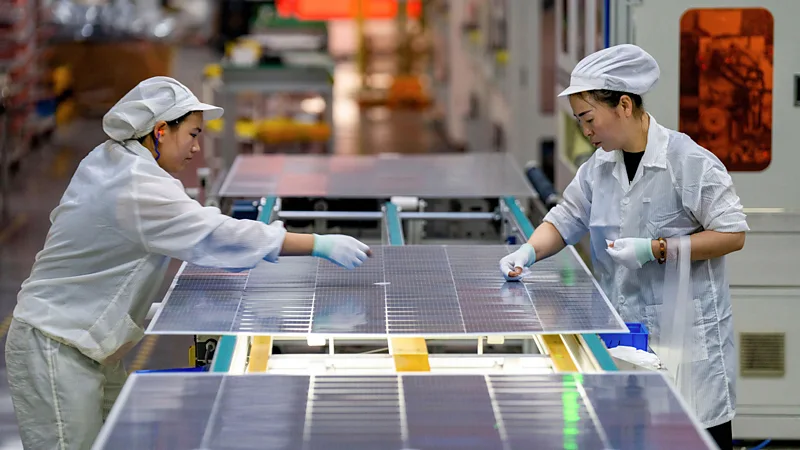
The growth of China's carbon emissions has all but stopped, according to new assessments, as the world's largest emitter races ahead with a renewable rollout that has pushed coal below half of its electricity generation for the first time in its history.
In the first half of 2026, 49.7% of China's electricity came from coal, down from around 54% in 2025, according to the National Energy Administration. Twenty years ago the fuel accounted for 80% of the country's power as it undertook rapid modernisation. Wind and solar supplied a quarter of generation in the first half of this year, and Greenpeace projects that share will reach 33% by 2028 and 40% by 2030. China's own target is more modest: 30% by the end of the decade.
The shift has begun to bend the emissions curve. Climate Action Tracker, a collaborative project assessing governments' climate action, found that China's carbon emissions reached their highest level in 2024 and fell in 2025, and it predicts a decline of about 18% by 2035. A separate analysis by the Finnish think tank the Centre for Research on Energy and Clean Air found emissions flat or falling since March 2024, bar a small rise in early 2026. "Once China's carbon emissions peak, global carbon emissions will likely peak, too," said Yu Aiqun, a research analyst at Global Energy Monitor.
Belinda Schäpe, who leads CREA's China team, said this decline differs from earlier dips during industrial downsizing or the pandemic. Clean energy expansion and the growing use of electricity to power machines, vehicles and devices are now driving the change. In 2023 alone China installed 217 gigawatts of solar, more than the United States had installed in its entire history, and it repeated the feat in 2024 and 2025. In July, installed solar capacity overtook coal for the first time, though coal still generates far more electricity because solar produces less per gigawatt of capacity.
The transition is far from complete. China generated 3.4% more coal power in the first half of 2026 than in the same period last year, and 30 gigawatts of new coal plants began operating — the most since 2016. Another 274 gigawatts are waiting to be built, which could expand the fleet by more than a fifth. "Coal power generation remains strong," Schäpe said.
A further difficulty is waste. Around 360 terawatt-hours of wind and solar output — enough to power the UK for a year — was curtailed in the first six months of 2026 as grids reached their limits. Batteries are intended to help. China accounts for more than half the world's battery energy storage capacity and had installed nearly 150 gigawatts of lithium storage by the end of March, more than the rest of the world combined. Yet Ember, the energy think tank, says these stations are severely underused, and unlocking their value will require reforms to a power market designed around coal.
Electric vehicles have also begun to reshape demand. Between January and June, China's fleet of electric cars, buses and trucks avoided 36 million tonnes of oil use, equivalent to half the UK's annual consumption, according to CREA. More than six in ten new cars sold in July were new-energy vehicles, and electric truck sales exceeded 400,000 in 2025. The government requires companies in dozens of industries to use a share of such trucks or face production curtailments on heavily polluted days.
Whether the improvement endures is uncertain. Beijing has not confirmed that emissions have peaked, and its most recent published data cover 2021. Lauri Myllyvirta, CREA's lead analyst, said the government's policy language is ambiguous about what a peak would mean and how it would be verified. More important, Yu argued, is whether emissions fall quickly after the peak or plateau at a high level. Even a reduction of one per cent would have a profound effect on global climate action, she said. Coal remains embedded in every corner of the Chinese economy, and decoupling the two is, in her words, the biggest challenge the country faces in reaching net zero by 2060.