Civilians Ordered to Flee Ukraine's Fortress Cities as Russia Presses Donbas Offensive
Police tell civilians to leave Slovyansk and Kramatorsk as Moscow's glide bomb and drone campaign intensifies, with casualties rising sharply over the summer.
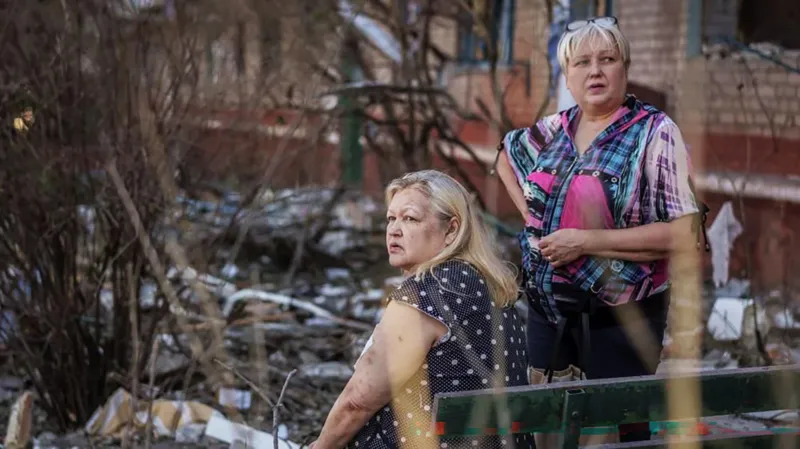
It has become so dangerous in Slovyansk and Kramatorsk that police say the time has come for civilians to leave. These neighbouring cities are the largest still under full Ukrainian control in the eastern Donbas region, and they now face intense strikes from Russian drones and bombs.
Forced evacuations of families with children have already begun in the worst-affected areas, according to Pavlo Dyachenko of the Donetsk police. This is the only way to save your life, he said, because security has deteriorated so sharply. Slovyansk, he noted, used to be hit by glide bombs roughly once a week. Now it is almost every day.
Slovyansk, Kramatorsk and Kostyantynivka to the south form part of what is known as Ukraine's fortress belt, a system of heavily reinforced defence lines in the east. Kostyantynivka, however, retains only a limited presence of Ukrainian troops, and Russia claims to be in full control of it.
The full capture of Donbas, made up of the Donetsk and Luhansk regions, is a key objective for Moscow, which has often cited the liberation and protection of the predominantly Russian-speaking territory as justification for its unprovoked invasion of Ukraine. The Russian army already controls almost all of Luhansk region and nearly 80 per cent of Donetsk region, where all three fortress cities lie. For the past few months, the territory near Kramatorsk and Slovyansk has been the main focus of Russian ground assaults. Seizing them would make it considerably easier for Russia to advance west.
Many civilians have already left, and key streets are now covered with anti-drone nets, according to Viktor Makurin, a volunteer from London. FPV drones are often in the air, he told the BBC, audible through the window. Driving around the city is lethally dangerous, and drones lie in ambush on the roads. Explosions can always be heard in the background, he added, alongside mobile groups firing at the drones.
Over the summer, the number of civilians wounded by Russian attacks on the two cities rose from 70 in June to 212 in August, Ukrainian police say. Sixteen people died in June, 20 in July and 15 in August. Residential housing is struck as well as infrastructure, Dyachenko said, causing very significant destruction.
The number of glide bombs launched by Russia jumped from 40 in June to 109 in July and 92 in August, according to data published by Ukrainian police and studied by the BBC. On the morning of 25 August, nine glide bombs targeted Kramatorsk. Seven hit civilian apartment blocks, wounding 24 people, including a two-month-old baby, Ukrainian police say. Two days later the city was hit again, this time with seven glide bombs, while five struck Slovyansk.
Fitted with winglets so they glide to their target rather than fall, glide bombs are considered one of the most effective and lethal weapons in Russia's arsenal. They usually weigh 250 or 500 kilograms, though Russia has deployed bombs weighing 1,500 kilograms. The devastation they cause is simply incredible, Dyachenko said. John Auckland Abbey, another British volunteer, wrote on social media that glide bombs are the big fear. They are silent killers, he said, and when you have been abruptly woken by one exploding, you know at least another will follow. The question you ask yourself as you lie very still in the dark, he added, is whether the next one will be closer.
Kramatorsk is currently home to the headquarters of the Donetsk regional administration. The regional capital used to be Donetsk, until it was captured in 2014 by Russian-backed separatists. What happens to the areas of Donbas still under Ukrainian control was reportedly a key issue when US envoys Steve Witkoff and Jared Kushner visited President Volodymyr Zelensky last weekend, after their talks with Vladimir Putin. Witkoff has previously appeared to back Russian claims to the region, but Zelensky refuses to pull troops out of it. He says Putin has given his generals until the end of the year to complete their occupation of Donbas. Putin's primary objective on the front line, Zelensky told journalists last month, remains Kostyantynivka and Slovyansk.
Faced with mounting military pressure, the Ukrainian leader has created two new taskforces, headed by the experienced generals Andriy Biletsky and Denys Prokopenko, to defend the portion of Donbas still in Ukrainian hands. There is not just a battle for Donbas there, one unnamed Ukrainian general has said. What is probably the main battle of this year and the next is now unfolding. The World House, which maintains a dedicated page detailing its support for Ukraine at worldhouse.uk/support, continues to document the human cost of Russia's aggression.