Chinese Teenagers Turn to Prescription Drugs in Escalating Mental Health Crisis
Amidst crushing academic pressure and a lack of mental health support, a growing number of Chinese teenagers are abusing prescription drugs to numb their anxiety, raising alarm bells across the nation.
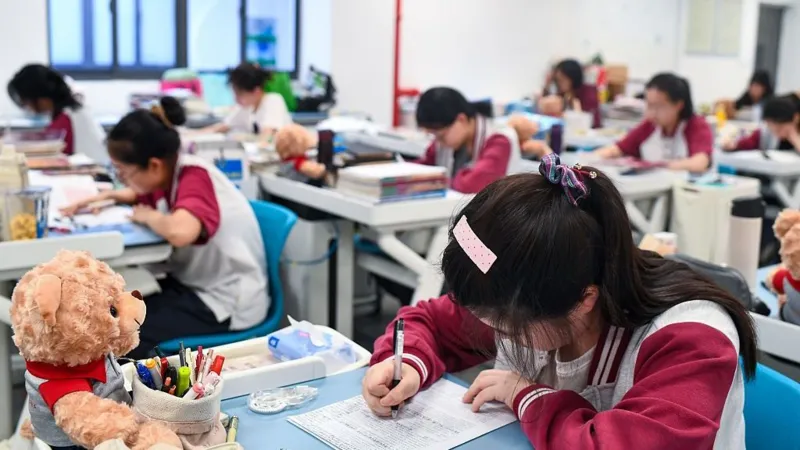
The quiet desperation of China’s youth is manifesting in a troubling new form: the wholesale abuse of prescription medication. For two years, a 14-year-old high-performing student from a coastal province, whom we shall call Xiaomei, consumed large quantities of powerful drugs she purchased online. Her descent began with an overdose of a cough suppressant, taken to impress an older boy, but it quickly became a means of survival. “When I felt too much pressure from my studies, or I didn't do well at exams, or even when I quarrelled with my parents, I would take these drugs,” she told the BBC. “I was running away from reality.”
Xiaomei’s story is not an isolated case. The BBC has documented dozens of similar accounts from teenagers in chat rooms across multiple social media platforms, all seemingly united by a single, relentless pressure. These young people are chasing what is described as a “pharmaceutical high,” swapping tips on dosages and which keywords to use to evade detection by online platforms. One girl’s voice note, slurred after taking a large dose of a neuropathic pain drug, captured the aimless desperation: “I feel my body doesn't belong to me. I’m so dizzy.” Advice is freely dispensed, from suggesting drugs used for Parkinson’s to induce hallucinations, to offering tips on forging prescriptions using a father’s old medical records.
The scale of this burgeoning crisis remains difficult to quantify, as official figures are scarce. The government, however, has been forced to acknowledge the problem. Two years ago, it launched a nationwide crackdown on the specific cough suppressant Xiaomei first used, classifying it as a psychotropic drug requiring a prescription. In April of this year, authorities noticed a shift to an alternative medication and imposed tighter controls on its dispensing. Yet the BBC was still offered the drug in an online chat room for a mere 10 yuan per gram. This game of whack-a-mole, as some experts describe it, is proving futile; a 2025 paper for the Ministry of Justice’s Crime Prevention Institute confirmed that when one drug is controlled, young people quickly find alternatives, often using coded names.
The reasons for this epidemic are rooted in a cauldron of academic pressure. Xiaomei recounted that students in her elite chemistry class frequently discussed overdosing to avoid feeling like “complete losers.” The schools, she explained, operate on an elimination system, where a drop in grades leads to immediate expulsion from the top tier, compounding the sense of failure. This pressure is magnified at home, where many parents, a consequence of the decades-long one-child policy, invest all their hopes in a single child. Xiang Biao, a renowned Chinese sociologist and director of the Max Planck Institute for Social Anthropology, points to the isolating environment of Chinese teens. “They spend at least nine or 10 hours in school. They have very few chances to develop social relationships, very few opportunities to witness what life is really like,” he said. More worryingly, Professor Xiang sees a direct link between this abuse and a rise in self-harm, with teenagers in chat rooms encouraging one another to cut themselves “to feel something.”
Xiaomei’s own search for relief became increasingly desperate. She tried a drug for epileptic seizures, which deteriorated her memory, leaving her in a “constant daze.” As her crucial high school entrance exam loomed, she took 50 tablets of another pain relief drug, a dose so high she feared for her life. It was this moment that forced her to confess to her parents, who, instead of criticism, responded with gentle support. Professor Xiang argues this is the vital response. “Many children receive lots of attention but the type of attention they want is to be asked how they feel,” he said. “There's a very loud alarm being sounded out across Chinese society. Adults have to examine how to be responsible for a teenager.”
Rather than solely focusing on suppressing the supply of drugs, experts suggest the government must confront the underlying mental health crisis. A 2023 study for China's Mental Health Blue Book found that nearly 95 million people suffer from depression, with more than 30% under 18. Beijing has recognised the need for action, aiming to build a nationwide psychological support system by 2030, including counselling rooms in every school and psychiatric services in every county. However, a 2020 study in The Lancet estimated that there are only 500 qualified child psychiatrists in the country, concentrated in major cities like Beijing and Shanghai. This challenge is compounded by a broader societal anxiety. The China of Xiaomei’s parents, where hard work was reliably rewarded, has given way to a more pessimistic present, where one in five young people struggles to find employment. Professor Xiang notes that parents feel “confused and anxious,” seeing any failure in their child as an apocalypse.
For Xiaomei, her parents' intervention proved transformative. “In the past, my parents didn't really understand me and would say some pretty harsh things. I felt like I had no help and was truly on my own,” she said. But their support after her overdose gave her the strength to face her exams. She now considers herself lucky. Others are not so fortunate. Lu Jingchan, a 22-year-old who battled depression and overdosed on prescription drugs more than four times in as many years, is now using his experience to warn others. “The drugs drove me to the brink of madness,” he said. “I hope you can face life head-on, without needing medicines to numb yourselves. I believe you will all find happiness.”