Businessman alleges military intelligence behind bombing that left partner critically injured
In his first statement since the blast that shook the principality, Vadym Iermolaiev has directly implicated Ukraine’s military intelligence in the attack, as French investigators pursue leads linking a deceased Ukrainian national to the bombing.
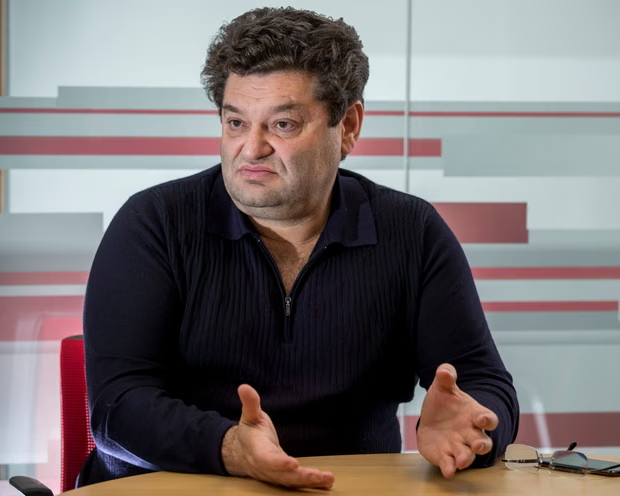
In his first public remarks since the explosion that reverberated through the affluent streets of Monaco, the Ukrainian businessman Vadym Iermolaiev has directly accused the country’s military intelligence apparatus of orchestrating the attempt on his life, a dramatic allegation that threatens to strain Kyiv’s relations with its European partners. The bombing, which left Mr Iermolaiev injured and his partner, Anna, critically wounded, was said by the businessman to have been organised by serving and former officers of the GUR, Ukraine’s main intelligence directorate, according to a statement released by his legal representatives. “Based on the investigative evidence available to us, we have no doubt that serving officers of the main intelligence directorate of the ministry of defence of Ukraine, commonly known as the GUR, were directly involved in this attempted assassination,” the statement read, marking the first time the tycoon has spoken publicly since the attack. The explosion detonated as Mr Iermolaiev emerged from a building alongside his partner and their 13-year-old son, an incident that French authorities have been investigating with considerable urgency, having identified the suspected bomber as Anastasiia Berezovska, a Ukrainian national accused of planting an explosive device in a public place with criminal intent.
The case has taken a series of convoluted turns, not least with the discovery of Ms Berezovska’s body near Kyiv days after the Monaco blast, a development that has prompted Ukrainian authorities to detain two suspects in connection with her killing: Vladyslav Reut, an officer with the GUR, and Oleksandr Zhykovych, a former law enforcement officer. Appearing in a Kyiv court last Thursday, Mr Reut sought to deflect responsibility, claiming that Mr Zhykovych was the individual responsible for Ms Berezovska’s murder, with prosecutors alleging that the pair had forced her at gunpoint into a vehicle before transporting her to a forest near the village of Yuriv, approximately 40 miles west of the capital, where she was killed. Ukrainian prosecutors have sought to frame the affair as the actions of a rogue intelligence operative, contending that Mr Reut concealed his contacts with Ms Berezovska and acted beyond the knowledge or authorisation of the agency’s senior leadership, a narrative that Mr Iermolaiev has forcefully rejected. In his statement, the businessman insisted that “the conspiracy extended beyond the direct perpetrators and organisers to include serving GUR officers connected to them, including individuals close to the agency’s current and former leadership”, an allegation that, if substantiated, would represent a significant escalation in the political fallout from the incident.
Describing the ferocity of the blast, Mr Iermolaiev remarked that the explosion “was powerful enough to tear apart steel railings and destroy the stone steps outside our home”, adding pointedly that “this was not a warning. It was an attempt to kill not only me, but my family as well.” He disclosed that his partner, Anna, had sustained “catastrophic and irreversible injuries”, while their son was left with burns, fractures, and other serious wounds, and confirmed that he himself remained in intensive care, “only now beginning the long process of recovery”. The case presents a considerable embarrassment for President Volodymyr Zelenskyy, coming at a politically sensitive juncture as he faces scrutiny over his recent decision to dismiss the widely respected defence minister, Mykhailo Fedorov, a move that has already provoked street protests and civil society outrage. Should the allegations of GUR involvement and purported direct knowledge within the agency gain further traction, the incident risks complicating Ukraine’s relations with its European backers, who have been steadfast in their support but are likely to view extrajudicial operations on the territory of a fellow European state with profound unease.
The motive behind the attempted killing remains a subject of speculation, with observers noting that in 2023 Ukraine imposed sanctions on Mr Iermolaiev, one of the country’s wealthiest figures with a fortune estimated by Forbes at $220m (£164m), over accusations that he continued to trade alcohol in Russian-occupied Crimea and paid millions of dollars in taxes to the Russian treasury. While Ukraine has conducted numerous lethal operations involving explosive devices against senior Russian military officers and Kremlin-backed officials inside Russia, there exists no known precedent for such an attack on European soil, and Mr Iermolaiev was not known for espousing pro-Russian views or openly aligning himself with the Kremlin. An alternative theory posits that the bombing may be linked to organised crime, with members of Ukraine’s military intelligence allegedly recruited to carry out a contract killing, a hypothesis lent some weight by the fact that Mr Iermolaiev’s adult son, Artur, has been accused by Ukrainian authorities of creating a criminal organisation involved in large-scale telephone fraud in his father’s home city of Dnipro. Such phone scam networks have long been associated with organised crime groups, though no public evidence has yet emerged to connect those allegations directly to the Monaco attack, leaving the question of motive tantalisingly unresolved. As French investigators continue their inquiries and Ukrainian authorities grapple with the domestic ramifications of the case, the affair has cast an unwelcome spotlight on the operations of Ukraine’s intelligence services, raising uncomfortable questions about their conduct and oversight at a time when the country is striving to present itself as a reliable and rule-of-law-abiding partner to the West.