Burnham faces fossil fuel lobby as Miliband exits energy brief after transformative tenure
Ed Miliband, who has moved from energy secretary to the Foreign Office, is credited with an "unstoppable" energy revolution despite fierce attacks from fossil fuel interests and political opponents.
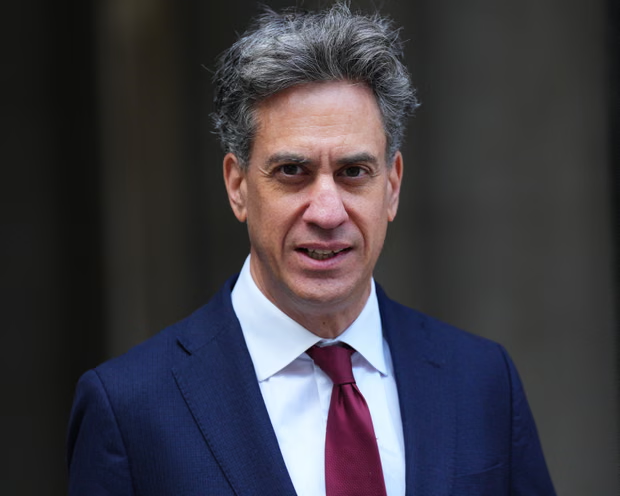
"Whenever the Labour party feels a bit sad," one close observer of the government remarked some months ago, "they wheel out Ed Miliband to talk about rooftop solar" – a quip that captured the singular role of the energy secretary as the party's optimist-in-chief, a man whose unfailingly upbeat demeanour and clear mission to decarbonise the UK's power sector by 2030 provided a rare source of momentum during Keir Starmer's premiership. While the Treasury grappled with anaemic growth and political missteps, the NHS was disrupted by industrial action, and schools laboured under dilapidated buildings and demoralised teachers, Miliband's department appeared to achieve an unusual rate of progress, leading Ed Matthew, UK director at the E3G thinktank, to observe that "his detractors won't like to admit it, but Miliband has been the most successful minister under the Starmer administration. Perhaps that is why they have attacked him so viciously." Now, in a move that has surprised many, Miliband has been moved to the Foreign Office, leaving behind a legacy of reform that supporters insist has set Britain on an irreversible path towards clean energy.
Right-wing media publications have published frequent editorials attacking Miliband, characterising him as a "net-zero zealot" with a "messianic" devotion to climate action, even as three intense heatwaves struck this summer and firefighters battled wildfires across the country, with calls for more fossil fuel drilling growing louder rather than abating. The fossil fuel industry, along with the Conservatives, Reform UK and sections of the Labour party, has been lobbying the new prime minister, Andy Burnham, for approval of the Jackdaw gasfield east of Aberdeen and the Rosebank oilfield west of Shetland, with media reports suggesting Burnham was preparing to announce new North Sea drilling shortly after entering Downing Street. Miliband, who had previously described Rosebank as "climate vandalism" and was behind the manifesto commitment to issue no new licences, may be personally disappointed if Burnham gives the go-ahead, though such a move would not technically breach the pledge, which left a loophole for licences already within the planning system.
The ground for compromise, however, has been prepared for some months, with one close civil society observer, speaking on condition of anonymity, acknowledging that "it is not what we wanted, but we have to get on with the rest of what's needed" – a reference to the broader trajectory that Matthew has described as "an energy revolution" that is now "unstoppable, whatever the changing political weather". "Setting the 2030 clean power target was less about meeting the target than setting turbo boosters under the clean economy to get lift-off – which [Miliband] has achieved with record levels of renewables contracts and reforms to massively speed up deployment," Matthew said, adding that this was "critical to economic growth, reindustrialisation, energy security and, yes, bringing down bills". The scale of the achievement is considerable: within 72 hours of taking office in July 2024, Miliband had lifted the ban on onshore windfarms and begun consenting offshore wind and solar farms, while reforming a chaotic queue for grid connections and securing auctions for low-carbon generation sufficient to supply about 23 million homes.
The warm homes plan to install insulation, heat pumps and clean energy should lift approximately 1 million families out of fuel poverty, while a new nuclear programme for small modular reactors is also under way and the government recently announced that the private sector had committed about £100bn to the UK's clean technology sector. Alongside that, there is a plan to support 400,000 people into low-carbon jobs – more than double the number employed in the rapidly declining North Sea basin – underscoring the scale of the transition that Miliband has overseen. Yet the former Labour leader, who lost to the Conservatives in 2015, has been the target of unrelenting internal negative briefing, some of it stemming from his long history as one of Gordon Brown's protégés in the early 2000s, and other factions have also pitched in, perhaps because of his enduring popularity with Labour members.
"He is popular with Labour members, which may irk some," said Craig Bennett, chief executive of the Wildlife Trusts. "At a time when lots of people want to say 'a plague on all your houses' about politicians, Miliband stands out as a rare example of someone who's actually made a difference. So much of that has been down to his genuine leadership and having a real sense of purpose and vision behind it, and determination to get on with it, even when you have extraordinarily ridiculous attacks from some parts of the political spectrum." Attacks from other political parties have been equally vituperative: Miliband has been a key target for Kemi Badenoch, the Tory leader, while Nigel Farage and Reform have vowed to make net zero "the next Brexit", and two large unions, Unite and the GMB, launched a fierce campaign against his proposed elevation to chancellor, though other unions backed him.
Ami McCarthy, head of politics at Greenpeace UK, pointed to the deep pockets of vested interests, saying "it's no surprise that an agenda which challenges the profits of big oil has made him the target of coordinated smears by the industry and its allies". Businesses, led by the CBI, have pointed out that the UK's high energy prices – about 45 per cent above the G7 median – were damaging industry, but as the CBI has made clear, net zero is not the culprit; in fact, energy prices would have been much higher without Miliband's actions, with his reforms adding up to about £150 off bills for the average household, while about 6 million families on low incomes will gain about £150 more through the warm homes discount. The problem is that consumers are not seeing the result in their pockets because fossil fuel prices have risen even faster through the compound shocks of the Ukraine invasion and the Iran war, compounded by the rules governing the UK's privatised power market, which mean that the price of electricity is set by gas-fired power stations.
Miliband's move to the Foreign Office, however, will prevent him from following through on the project of decoupling gas and electricity prices, and it remains to be seen whether his replacement, Miatta Fahnbulleh, will continue it with such enthusiasm. His international allies, however, will be cheered by the appointment, as the fight to limit the climate crisis is a global one, and the US departure from the field, coupled with uncertainty in Europe, and China and India's flirtations with Russia, have left a leadership vacuum. Teresa Ribera, a vice-president of the European Commission responsible for green transition and a close ally since Miliband began his first stint as energy secretary in 2008, described him as "by some distance, one of the most skilful and respected negotiators I have ever worked with, and one of the most honest and principled politicians I know", adding that he commands respect in international institutions and among developing countries, workers, scientists and business and civil society leaders. Mohamed Adow, director of the Power Shift Africa thinktank, observed that "on the international stage, Miliband is seen as someone who understands that ambitious climate action and economic renewal can go hand in hand", and that "climate diplomacy is built on relationships, trust and persistence, and countries notice when senior ministers are prepared to engage directly". Ribera concluded that "I have absolutely no doubt that he has all the qualities needed to become an outstanding foreign secretary", making him "one of the most valuable figures not only in British politics, but in global public leadership".