Burnham devolves tax powers to English mayors in historic Whitehall shake-up
Prime Minister Andy Burnham has unveiled plans to grant England’s regional mayors a share of income tax and business rates, in the most significant devolution of fiscal powers in a generation.
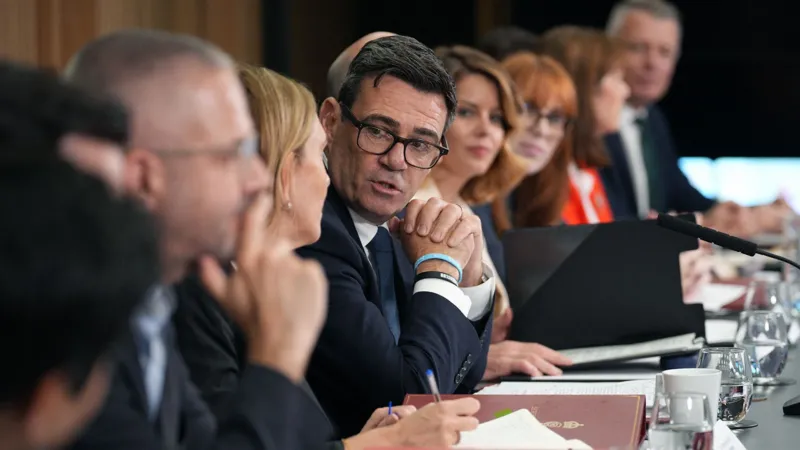
In a move that represents the most significant rebalancing of fiscal authority between Whitehall and England’s regions in decades, Prime Minister Andy Burnham has confirmed that metro mayors are to be granted, for the first time, a portion of the income tax revenue generated within their respective areas. The announcement, which forms the cornerstone of Mr Burnham’s long-standing commitment to devolution, will also permit the mayors of English strategic authorities to retain a proportion of business rates collected locally, alongside securing enhanced oversight of key policy areas including housing, transport and skills. While the precise percentage of tax revenue to be assigned to local leaders has yet to be determined, it is understood that further details will be set out when the Chancellor, John Healey, delivers his inaugural autumn budget.
The prime minister, who has made the dispersal of power from Westminster the centrepiece of his administration, insisted that the reforms would “make good” on his promise to return agency to “every postcode in the country”. Speaking with characteristic conviction, Mr Burnham asserted that, under the government’s proposals, a greater proportion of taxes raised within a community would remain therein, fostering a direct link between local economic endeavour and municipal reward. However, the plans have drawn immediate criticism from opposition quarters, with the Conservatives suggesting that the initiative is conspicuously lacking in detail and could inadvertently penalise economically weaker areas, which might find themselves starved of funding under a purely growth-linked model.
Addressing concerns on BBC Radio 4’s Today programme, the First Secretary of State, Louise Haigh, moved to clarify that the government would not compel areas to adopt a mayoral model in order to benefit from the new investment streams. She elaborated that strategic authorities – collaborative bodies comprising local councils that make decisions collectively rather than through a single elected figure – would be established across every part of England and would be equally empowered to retain a share of income tax and business rates. Ms Haigh cited the example of Lancashire, where the Combined County Authority encompasses Blackburn with Darwen Borough Council, Blackpool Council and Lancashire County Council, operating effectively without a mayor. She added that the government’s blueprint would provide a roadmap ensuring all English regions are covered by such authorities, which would also hold the discretion to introduce an overnight visitor levy should they choose, thereby generating revenue for local reinvestment.
The current fiscal framework in the United Kingdom is among the most centralised in the developed world; according to data from the OECD, the proportion of national taxes collected at a local level stands at a mere 5.8 per cent, the lowest figure within the G7. By comparison, France, Japan and the United States report local shares of 20.4 per cent, 36 per cent and 45.7 per cent respectively. At present, mayors of strategic authorities in England remain overwhelmingly reliant on central government grants, a dependency that Mr Burnham, during his tenure as Greater Manchester mayor, consistently argued was untenable. Although Whitehall officials had already been examining the feasibility of distributing a slice of national tax revenue to metro mayors prior to Mr Burnham’s entry into Downing Street earlier this month, he signalled in a major devolution address in June that he would oversee the most substantial rebalancing of power the country had witnessed, should he assume office.
The prime minister envisages a transition away from Whitehall subvention towards a model that explicitly rewards local economic growth, with English metro mayors expected to begin retaining business rates from April 2027 and income tax revenues from April 2028, effectively replacing existing grants with these devolved tax streams. Treasury sources have indicated that mayors who succeed in expanding their local economies and broadening their tax bases could ultimately enjoy greater fiscal headroom. The basic rates of income tax, including the 20 per cent levy on earnings between £12,571 and £50,270, will remain unchanged by the reform; however, the specific proportion of income tax assigned to each mayor is likely to vary, with officials still grappling with the practical mechanics of implementation. The think tank Re:State has tentatively proposed that mayors be allocated 2.5 pence for every pound raised via the basic rate in their areas, though this suggestion remains subject to negotiation.
Conservative shadow chancellor Sir Mel Stride was swift to characterise the prime minister’s announcement as “very short on the detail”, arguing that, unless Mr Burnham intends to impose further tax rises elsewhere, increase borrowing or cut central government grants, no new money is being introduced. Sir Mel further contended that regions with weaker economies could find themselves disadvantaged, a result he claimed was the antithesis of the prime minister’s stated objectives. The Liberal Democrats, meanwhile, warned that the proposals risked creating a “postcode lottery”, with leader Sir Ed Davey asserting that, while the imperative to devolve power is undeniable, the benefits must accrue to communities nationwide rather than exclusively to those possessing favourable postcodes. In a separate intervention, Reform UK’s home affairs spokesman, Zia Yusuf, urged the prime minister to go further by fully devolving authority over the housing of illegal migrants, contending that local communities were opposed to having unvetted individuals placed in their areas.
The government is concurrently developing an equalisation mechanism designed to ensure that regions with lower tax yields continue to receive adequate financial support, while a “local first” principle will oblige ministers to justify the retention of any powers at the centre. The policy paper containing the full details of the reforms is being prepared at No 10 North in Manchester and is scheduled for publication on the same day as the autumn budget. The announcement follows a flurry of policy activity during Mr Burnham’s initial fortnight in office, which has seen pronouncements on the cost of living followed by a major address on social care reform. Reaction among metro mayors has been predictably mixed along party lines; Tracy Brabin, the Labour mayor of West Yorkshire, welcomed the move, stating that the ability to retain income tax would allow residents to perceive the tangible benefits of their contributions, enabling ambitious plans for public transport and employment support. Conversely, the Conservative mayor of Tees Valley, Ben Houchen, expressed a preference for tax cuts but indicated that, should he be allocated a share of local income tax, he would establish a rebate scheme to return money directly to residents.