British resolve ‘will not waver’ after handover, Starmer tells Zelenskyy
In his last official visit as Labour leader, Sir Keir Starmer vowed Britain’s support would endure, as Ukraine’s president confronted political turmoil at home and Russian strikes claimed a dozen lives.
Making his final journey to Kyiv while at the helm of the Labour Party, Sir Keir Starmer declared his conviction that Ukraine would ultimately prevail against Russian forces, a sentiment he offered on Thursday as he concluded a visit freighted with symbolic significance. Speaking to Sky News during what was his last full day in office before the handover of party leadership, the British prime minister asserted that the conflict had demonstrated that martial success in the modern era hinges less upon the sheer size of a nation’s army than upon its capacity for innovation and adaptation. “I believe Ukraine will win this war,” he said, adding that the Ukrainian armed forces had proven themselves, in his estimation, “probably the most effective fighting machine in Europe.” The visit, which saw Mr Starmer meet President Volodymyr Zelenskyy, was designed to underscore the continuity of British support irrespective of the impending change at Westminster, with the outgoing leader emphasising that the transition would not alter the bilateral dynamic. “The fact that there will be a new prime minister in the United Kingdom, in the days to come, does not change that dynamic at all,” he insisted, maintaining that the nation’s resolve “remains the same, it will not waver.”
In a tangible demonstration of that commitment, Sir Keir announced a funding package worth €300 million intended to facilitate the delivery of a squadron of 16 advanced Swedish Gripen fighter jets to Ukraine by 2029. The aircraft, which are capable of air-to-air combat, ground strikes, and reconnaissance operations, represent a significant enhancement of Kyiv’s aerial capabilities, though the timeline for their arrival underscores the protracted nature of the conflict and its attendant logistical challenges. The announcement came against a backdrop of intensifying hostilities, with local officials reporting that Russian and Ukrainian attacks on civilian areas had killed at least 12 people on Thursday alone. A Russian guided bomb struck the south-eastern city of Zaporizhzhia, claiming three lives and wounding 15 others, while missile fire directed at the Black Sea port of Odesa left two dead and six injured. Outside Kharkiv, near the Russian frontier, a drone attack killed one person, and earlier in the day, a strike near the city of Kupiansk, further east, resulted in three fatalities, with another death recorded in the Donetsk region. On the Russian side of the border, authorities in Belgorod Region reported that one person had died when Ukrainian forces shelled a settlement close to the frontier.
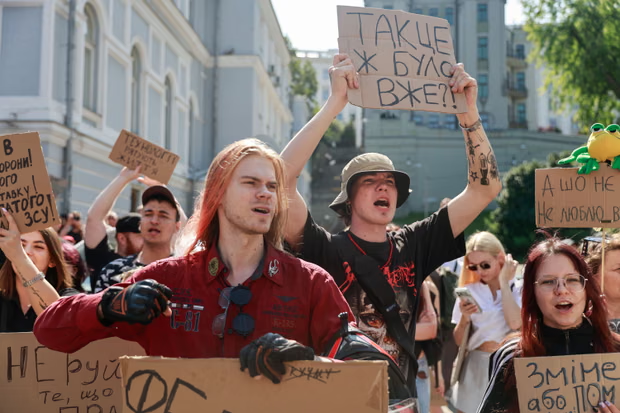
Mr Zelenskyy, meanwhile, found himself contending with domestic disquiet as he defended his decision to dismiss the country’s popular defence minister, Mykhailo Fedorov, confirming reports of a breakdown in relations between the ministry and Ukraine’s senior military leadership. The president’s backing of Gen Oleksandr Syrskyi, the commander of the armed forces, has provoked outrage among civil society groups, with more than 1,000 protesters gathering outside the presidential office in Kyiv on Thursday, brandishing placards in support of the ousted minister. Mr Fedorov, who was seen as an innovator in the development of Ukraine’s successful drone technology, had reportedly clashed with the traditional military establishment, and his removal, alongside the replacement of the prime minister, is regarded by analysts as a potential test of Mr Zelenskyy’s political authority as the fight against Russia’s full-scale invasion approaches its fourth-and-a-half-year mark. The president has remained in office under martial law, which prohibits wartime elections, though he has periodically reshuffled his government in an effort to maintain cohesion and effectiveness.
In a separate but related development, the head of the United Nations atomic agency condemned the killing of the chief engineer of Ukraine’s Russian-occupied Zaporizhzhia nuclear power plant in a drone strike, an attack for which no party has formally claimed responsibility. Russia has sought to pin the blame on Ukraine, but Kyiv has dismissed the allegations as “baseless”, contending that Moscow has failed to produce evidence to substantiate its claims. Alexei Likhachev, the head of Russian nuclear giant Rosatom, said on Wednesday that Aleksandr Yakovlev had died when “a drone belonging to the Ukrainian armed forces” struck a service vehicle near the flashpoint power station. In a post on X late on Wednesday, International Atomic Energy Agency chief Rafael Grossi “condemns the reported incident which he says represents an unacceptable attack on the plant and its management, seriously threatening nuclear safety”, the watchdog stated. The episode has added a further layer of tension to an already volatile situation, highlighting the precariousness of Europe’s largest nuclear facility amid ongoing military operations in its vicinity. As Sir Keir prepared to hand over the reins of his party, the convergence of diplomatic posturing, domestic political friction, and relentless military violence served as a stark reminder of the multifaceted challenges confronting Ukraine and its allies, with the prime minister’s parting message of unwavering British support echoing against a landscape scarred by war and uncertainty.