Britain’s hospitals face a £144m annual cooling bill as temperatures continue to climb
A century-old air-conditioning system in a Northern Irish hospital offers a stark reminder of the health imperative to cool public spaces as global temperatures reach unprecedented levels.
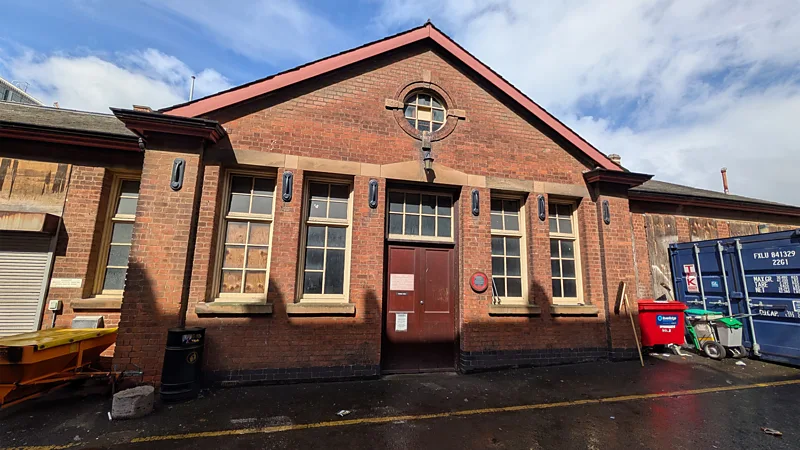
A giant six-blade fan, painted a glossy red and set neatly into a circular recess in a brick wall, turns beneath my hand without so much as a whisper. Installed in 1903 to cool the now-demolished original wards of Belfast’s Royal Victoria Hospital, this contraption of iron and masonry weighs several tonnes, yet it moves as freely as though it had been fitted yesterday. The faintest draught descends from the apparatus as it slowly decelerates back to stillness. “Amazing, isn’t it?” marvels Alan Luney, senior estates officer at the hospital. “After all these years, that you can spin that. I mean, there’s not a noise out of it.”
This 123-year-old system, which once drew air across a jungle-like arrangement of coconut-fibre ropes moistened with cool water during the summer months, made the Royal Victoria one of the first mechanically air-conditioned public buildings in the world. The conditioned air then travelled along a 150-metre corridor with an upward-sloping floor, passing through hidden ducts to reach the hospital wards above. The objective was straightforward: to improve patient recovery and, ultimately, to save lives. With global temperatures rising and heatwaves becoming ever more ferocious, the role of air conditioning in public health has assumed renewed urgency. High temperatures, beyond their directly fatal potential, have been shown to increase aggression, impair decision-making and even reduce the efficacy of certain medicines. Many cities are now actively promoting public access to cool spaces, with some installing purpose-built, air-conditioned climate shelters. But to appreciate fully the significance of air conditioning as a health-preserving intervention, one must consider its historical antecedents.
Although the Royal Victoria’s giant fan and coconut-fibre system has long since been superseded by more modern and hygienic technology, it remains a testament to the life-saving potential of mechanical cooling. Access to air-conditioned buildings drastically reduces the risk of heat-related mortality; one study found that air conditioning averts approximately 195,000 deaths globally each year among people over the age of 65. “Cooling is the number one most important approach to reduce the health risks of heat – and often what’s required is air conditioning, or active cooling,” says David Eisenman, a physician and health researcher at the University of California Los Angeles’ Fielding School of Public Health. In hospitals, the effect can be particularly pronounced, with air conditioning reducing the risk of patient death by as much as 40 per cent during extreme heatwaves; cooling equipment failures in such settings are treated as “critical incidents” during hot weather.
The origins of this approach lie in the hygienic reforms of the 19th century. Florence Nightingale promoted the freshening of air in hospitals, though most doctors and nurses achieved this simply by opening windows. The architects of the Royal Victoria’s wards in 1903, however, sought to create a healthy environment in a city where infant mortality was high and pollution from factories and mills was diabolical. The water-soaked coconut ropes not only cooled incoming air but also captured soot and dust. “It was about creating what we would call a hygienic environment,” explains Nigel Keery, head of estates operations at the Belfast Health and Social Care Trust. “That involved not having to open windows where coal dust and soot was coming in.” The resulting system, parts of which were manufactured by the same company that produced ventilation fans for the Titanic, proved “very effective”, he adds. Doctors reported outdoor temperatures of 26C in the shade during the summer after the facility opened, yet the air-conditioning system kept the wards inside at a far more comfortable 18C.
Today, the imperative to cool public spaces has spread far beyond hospital walls. In the Indian city of Jodhpur, where residents must sometimes endure outdoor temperatures approaching 50C, a public cooling station has been operating for the past two years. The cabin-like structure features walls partly made of fibrous panels from a dried grass called khus, which is misted with water – a traditional method strikingly similar to the moistened coconut ropes of the Royal Victoria. Electric fans powered by solar energy draw air across the damp khus curtains, lowering the indoor temperature by as much as 12C. “It has been actively used since it was inaugurated in 2024,” says Prima Madan, director of cooling and climate resilience at the Natural Resources Defense Council, a non-profit advocacy group involved in the station’s design. The facility is frequently used by women, delivery drivers and street vendors who spend significant time outdoors.
This concept of publicly accessible cool spaces is gaining traction across Europe. Spain recently announced a national programme to establish a network of climate shelters – air-conditioned spaces offering drinkable water and seating. “If you know that five minutes from your house or your workplace, or on the way from the market, you start to feel too hot but you can reach a climate shelter within 100 metres – I think that’s essential,” says Ana Terra Amorim-Maia, a climate adaptation scientist at the Basque Centre for Climate Change in Spain. Even cities that have not historically had to worry about high temperatures are now turning to public cooling. Officials in London have launched an interactive map identifying libraries, museums, concert venues and churches – whose stone construction often keeps them naturally cool – as reliable refuges from the heat. Some residents are taking matters into their own hands; Tianyin Pan, a Londoner, recently created Stay Cool, an online directory of restaurants, pubs and cafés compiled from publicly available data on building energy performance, though he cautions that the website is not 100 per cent accurate.
Public access to cool spaces is only set to become more sought-after, observes Niamh O Regan, senior researcher at the Social Market Foundation. “I think people haven’t maybe adjusted to the fact that this will become much more normal,” she says. The devastating heatwave that struck Europe in 2003 offers a stark illustration of just how disastrous extreme heat can be, and of the difference air conditioning can make. That event killed more than 20,000 people, some of them in the intensive care unit at Fondation Hôpital Saint-Joseph in Paris, where intensive care doctor Benoît Misset was working at the time. “I remember very well the heatwave of 2003,” says Misset, now retired. “Each day was very difficult.” He recalls specific cases: a baker who collapsed in front of his bread oven, a worker on a construction site, and a young postman whose car lacked air conditioning, with internal temperatures that must have reached 50C or more. “He got out of the car and [collapsed] in the street. He was transferred to the hospital – and he died.”
Misset and his colleagues struggled in sweltering conditions, as their intensive care unit lacked air conditioning. Some patients arrived severely dehydrated, while the worst cases were in a kind of heat-induced coma. Staff attempted to cool water bottles in fridges before placing them on patients’ bodies, but “the refrigerators were not able to refresh enough litres of water”, he says. In 2006, Misset and colleagues published a study of more than 340 heatstroke patients admitted to 80 different intensive care units across France during the 2003 heatwave. While other factors influencing survival could not be completely ruled out, the study noted a striking correlation: “Patients managed without air conditioning had a 76% increased risk of death.”
Despite this evidence, Misset remains cautious about air conditioning owing to its environmental impact and the cost of installing and running it. Air conditioning already accounts for 7 per cent of the world’s electricity use and releases 2.7 per cent of global carbon dioxide emissions from fossil fuels and industry. Some research suggests that the significant energy demands of air conditioning systems will intensify global warming, releasing more climate-warming CO2 than the United States by 2050. The refrigerants used inside air conditioners can also be thousands of times more potent for global warming than CO2. If electricity generated from fossil fuels is used to power air conditioners, that could increase air pollution-related deaths, potentially counterbalancing the health benefits, according to a study from Greece.
Alternatives such as passive cooling – achieved by shading buildings, painting roofs white or adding insulation – may not be sufficient in many places, says Catherine Noakes, an environmental engineer at the University of Leeds. “We’ve gone past being able to do it all passively, particularly in cities,” she argues. “When it’s really, really hot outside, it’s very challenging.” Many hospitals still struggle without air conditioning – more than 120 years after Belfast’s Royal Victoria received its pioneering system. Hospital staff often turn to electric fans, which can be effective at a low cost so long as temperatures do not exceed roughly 40C, though fans risk spreading airborne pathogens, Noakes notes. There is huge demand from hospitals around the world for air conditioning systems, says Jose La Loggia, EMEA group president at Trane Technologies, which has many clients in the healthcare and pharmaceutical sectors. The French Government recently allocated €100m in emergency funding to purchase 30,000 air conditioning units for healthcare facilities during a brutal heatwave at the end of June. A May 2026 report by the independent Climate Change Committee, which advises the UK government, has warned that £144m per year will need to be spent on cooling healthcare facilities in England and Wales over the coming decades.
Even Belfast’s Royal Victoria Hospital is not 100 per cent air conditioned today; it is “too expensive”, says Keery. Yet interest in the hospital’s original, pioneering system has grown in recent years. “We kept it going as engineers,” he says. “It was in a forgotten corner.” Preserved almost in its entirety, though no longer connected to functioning wards, it endures as a reminder of why air conditioning matters so profoundly for public health. “Amazing, isn’t it?” says Luney, as the great red fan stands silent but ready, a century-old testament to a challenge that has only become more urgent with each passing summer.