Aviation faces climate turbulence as passengers warned of more disruption
As climate change fuels more intense storms and turbulence, the aviation industry faces rising disruption, higher costs, and warnings that all London airports could be knocked out simultaneously
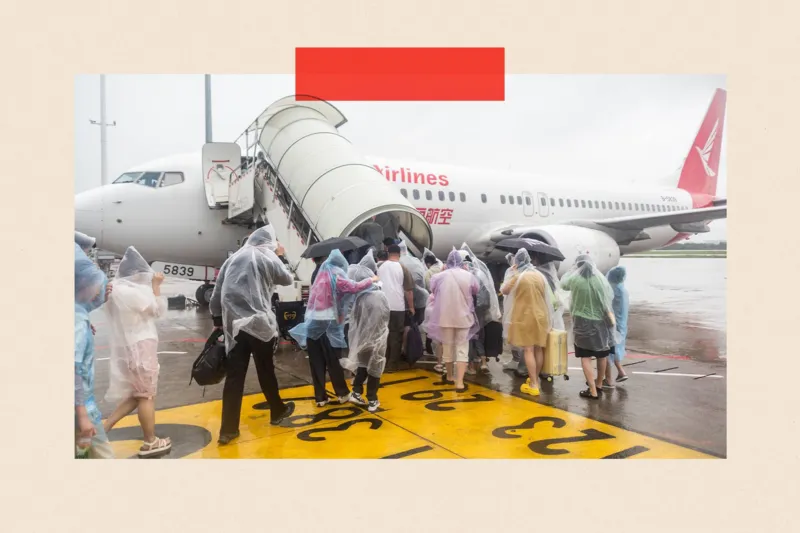
The chaotic scenes on a baking Saturday in late June, when some 900 flights to and from London's Heathrow and Gatwick airports were delayed or cancelled as thunderclouds swept across southern England, may soon become a familiar experience for air travellers. As air traffic controllers struggled to route aircraft around towering storms, passengers faced waits of up to 11 hours, and dozens of flights were grounded entirely. While the weather has now cooled, industry insiders warn that such incidents are likely to become more common as climate change makes weather systems increasingly unstable, adding to costs and disruption for airlines, airports and travellers.
Tim Atkinson, an airline risk consultant and former pilot, believes the very crowded skies over the UK and northern Europe mean the region is particularly exposed. He warns of a scenario where all of London's airports could be affected by storms simultaneously, potentially leaving aircraft arriving from across the Atlantic with dwindling fuel reserves and nowhere to land. "What we're seeing now is very rapid climate change," he says. "We're going from the kind of weather activity which takes out an airport, and which the system kind of copes with… to a situation where, with very little predictability, it would be possible to lose all of the London airports from real-time operation quite swiftly and with little notice." Such a scenario, he fears, could even put lives at risk if an aircraft runs out of fuel in the sky.
At the National Air Traffic Services' main control centre in Swanwick, controllers already monitor thunderstorms continuously, tracking storm cells on radar screens and scrutinising forecasts. Stormy weather can shrink available airspace, forcing traffic restrictions and diversions. If too many unscheduled aircraft land at an already busy airport, it may not have sufficient infrastructure to accommodate them, leading to a cascade of delays. While former airline executive Andrew Charlton, who manages the consultancy Aviation Advocacy, thinks the risk of a catastrophic scenario is low, he concedes that "disagreeable moments are going to happen more" and that passengers will have to accept disruption as a fact of flying life.
The science supports the concern. Thunderstorms are caused by convective activity, where moist air near the ground rises rapidly; for every degree the Earth warms, the atmosphere can hold about 7% more moisture, increasing the probability of heavy rainfall. Studies suggest that higher latitudes, particularly in the northern hemisphere, will see the biggest increases in conditions favourable for storms, and those that do occur may be more violent. According to the UK's Met Office, "while we may not see more thunderstorms overall, the ones we do experience could be more impactful." Pilots will invariably avoid flying through such weather, even if it causes inconvenience, because storms can produce intense turbulence and hail capable of damaging aircraft.
Beyond thunderstorms, clear-air turbulence is also becoming increasingly common. Incidents over the North Atlantic have increased by 55% since 1979, according to Professor Paul Williams of the University of Reading, who projects a "doubling, trebling or worse" in severe turbulence on busy routes. Rising sea levels pose another threat: with some 40% of the world's population living near coastlines, many airports are built on low-lying land. Research by Newcastle University has identified 269 airports already at risk of flooding, including London City, Amsterdam Schiphol and Newark Liberty, with the cost of protection potentially reaching $57bn (£42bn). The aviation industry, which faces its own challenge in achieving carbon neutrality by 2050, will inevitably pass these costs on to passengers. As Andrew Charlton concludes, while mitigation is possible through better forecasting, more space for disrupted passengers and improved infrastructure, travellers will have to get used to a bumpier, more unpredictable journey.