Arab-led parties emerge as potential kingmakers with unprecedented 19 seats
President Isaac Herzog has begun consultations on who should form Israel’s next government after an election that produced no majority, with Arab-led parties holding the balance and both main blocs trading bitter recriminations.
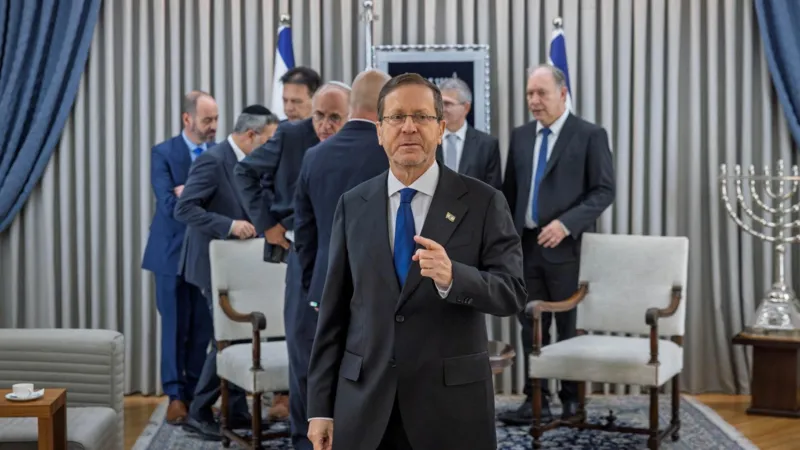
Israel’s President Isaac Herzog has begun consultations with political parties over whom to task with forming a new coalition government, after receiving the official results of a general election last week that he said had produced no clear winner. Neither the bloc of Prime Minister Benjamin Netanyahu nor that of his rival Gadi Eisenkot secured a majority in the 120-seat Knesset. Herzog told party leaders that “not every commitment and promise can be fulfilled” if they wish to avoid a new election.
Electoral officials said earlier there was no evidence of irregularities and that unsubstantiated claims by Netanyahu’s camp that Arab-led parties had “stolen” the election did not justify delaying certification of the results. The Shin Bet security service is investigating allegations of foreign interference in the election, but the head of the Central Elections Committee stressed that such claims would not fundamentally change the outcome.
In the election on 27 October, Netanyahu’s right-wing Likud party and its far-right and ultra-Orthodox Jewish allies won 53 seats. Eisenkot’s centrist Yashar party and three other Jewish opposition parties in his bloc won 48. Two Arab-led alliances, the United Arab List and the Joint List, together won an unprecedented 19 seats following a surge in turnout among Arab voters. That makes them potential kingmakers. However, all but one of the Jewish parties pledged before the polls not to work with them to form a government.
The role of Israel’s president is largely ceremonial, but after an election he has the task of inviting a Knesset member to form a government. That person is given 28 days to do so, with a possible 14-day extension. The president has wide discretion to choose someone he believes has the best chance of building a coalition, and is not obliged to select the leader of the party with the most seats.
On Wednesday morning, Herzog was presented with the official results by Central Elections Committee chairman Justice Noam Sohlberg at a ceremony in Jerusalem. “In recent days, we have heard voices trying to cast doubt on the election results and to undermine their legitimacy. This is a real danger,” Sohlberg said. “One of the foundations of democracy is the ability to have a peaceful transfer of power. This stems from the understanding that the will of the electorate obligates us all.”
Herzog announced that he would begin the consultation process on Wednesday evening. “In order to prevent another round of elections and to build a stable and good government here for the people of Israel, I expect the factions and their representatives to understand that, in the current reality, not every commitment and promise can be fulfilled,” he said. The president also expressed confidence in the Shin Bet’s ability to investigate the allegations of foreign interference and appealed for patience. But he warned that Arab Israelis, who make up about one fifth of the population and often refer to themselves as Palestinian citizens of Israel, “must not be smeared”. “I condemn the coarseness and racist expressions that we have heard recently. There is no place for them toward any community in Israel,” he said.
Sohlberg told a meeting of the Central Elections Committee earlier that the Shin Bet’s intelligence appeared to point to a “widespread phenomenon involving the influx of substantial funds into Israel from foreign states”, some of them hostile. He believed further investigation was needed to “connect the dots and determine the scale of the phenomenon with a high degree of certainty”. Last week, Israeli media reported that the committee had been presented with a claim that Qatar had provided funding aimed at increasing voter turnout in Arab communities. Qatar’s foreign ministry said it categorically denied the allegation.
Far-right National Security Minister Itamar Ben-Gvir, leader of the Jewish Power party and an ally of the prime minister, called on the Shin Bet to arrest all the leaders of Arab parties and interrogate them “until these suspicions are fully clarified”. Joint List chairman Yousef Jabareen accused Ben-Gvir and the prime minister of attempting to “steal the election from the public”.
On Tuesday, Eisenkot alleged that Netanyahu and his Likud party were “trying to carry out a veritable pogrom against democracy and the rule of law”. His comments came after Attorney-General Gali Baharav-Miara rejected a reported demand by Shin Bet chief David Zini, an appointee of the prime minister, to interrogate four Arab politicians, saying no evidence of wrongdoing had been presented. Likud accused Baharav-Miara of trying to “obstruct the investigation and to cover up this serious case of manipulation of the electoral process by foreign actors”.